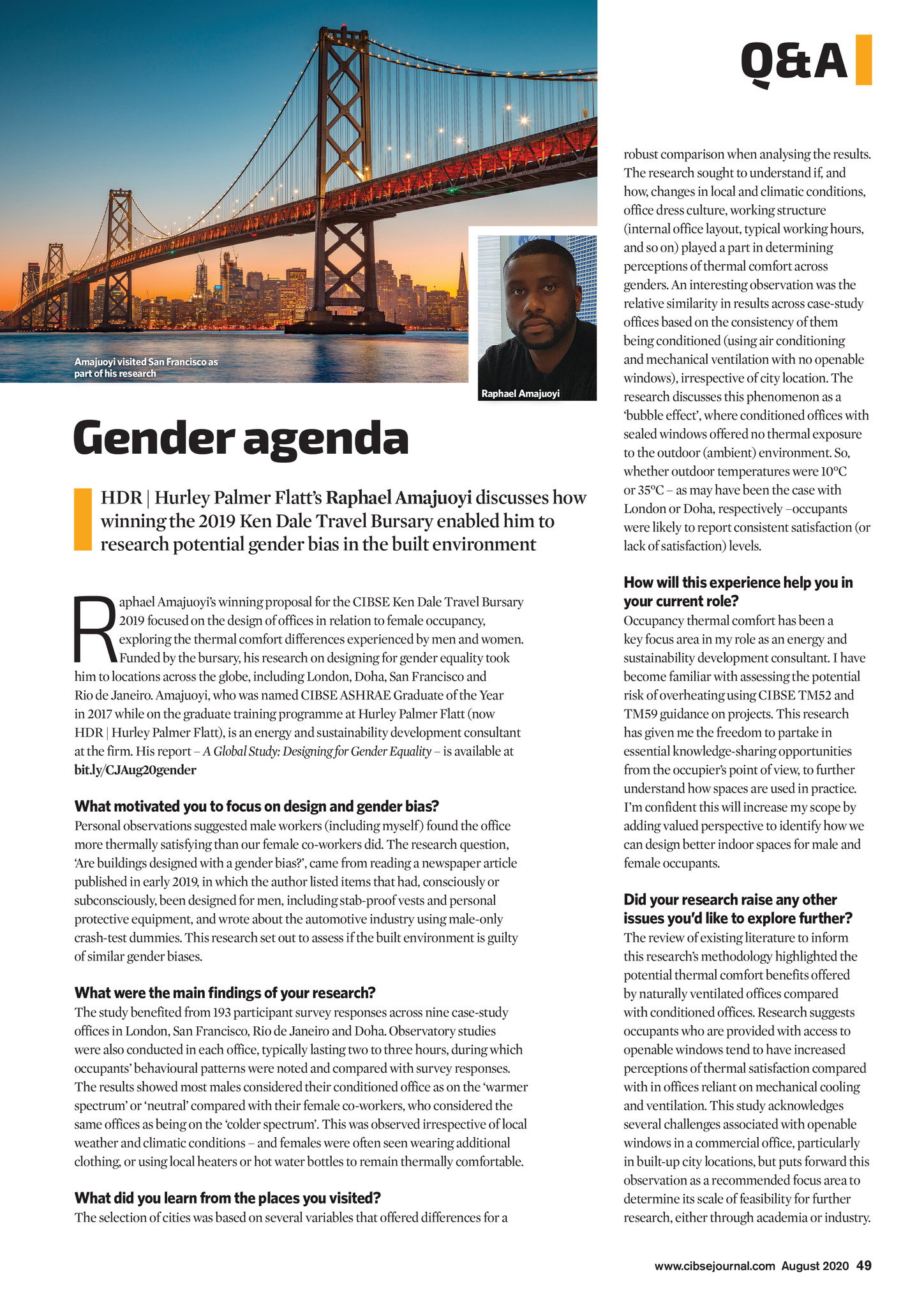
Q&A Amajuoyi visited San Francisco as part of his research Raphael Amajuoyi Gender agenda HDR | Hurley Palmer Flatts Raphael Amajuoyi discusses how winning the 2019 Ken Dale Travel Bursary enabled him to research potential gender bias in the built environment R aphael Amajuoyis winning proposal for the CIBSE Ken Dale Travel Bursary 2019 focused on the design of offices in relation to female occupancy, exploring the thermal comfort differences experienced by men and women. Funded by the bursary, his research on designing for gender equality took him to locations across the globe, including London, Doha, San Francisco and Rio de Janeiro. Amajuoyi, who was named CIBSE ASHRAE Graduate of the Year in 2017 while on the graduate training programme at Hurley Palmer Flatt (now HDR | Hurley Palmer Flatt), is an energy and sustainability development consultant at the firm. His report A Global Study: Designing for Gender Equality is available at bit.ly/CJAug20gender What motivated you to focus on design and gender bias? Personal observations suggested male workers (including myself) found the office more thermally satisfying than our female co-workers did. The research question, Are buildings designed with a gender bias?, came from reading a newspaper article published in early 2019, in which the author listed items that had, consciously or subconsciously, been designed for men, including stab-proof vests and personal protective equipment, and wrote about the automotive industry using male-only crash-test dummies. This research set out to assess if the built environment is guilty of similar gender biases. What were the main findings of your research? The study benefited from 193 participant survey responses across nine case-study offices in London, San Francisco, Rio de Janeiro and Doha. Observatory studies were also conducted in each office, typically lasting two to three hours, during which occupants behavioural patterns were noted and compared with survey responses. The results showed most males considered their conditioned office as on the warmer spectrum or neutral compared with their female co-workers, who considered the same offices as being on the colder spectrum. This was observed irrespective of local weather and climatic conditions and females were often seen wearing additional clothing, or using local heaters or hot water bottles to remain thermally comfortable. What did you learn from the places you visited? The selection of cities was based on several variables that offered differences for a robust comparison when analysing the results. The research sought to understand if, and how, changes in local and climatic conditions, office dress culture, working structure (internal office layout, typical working hours, and so on) played a part in determining perceptions of thermal comfort across genders. An interesting observation was the relative similarity in results across case-study offices based on the consistency of them being conditioned (using air conditioning and mechanical ventilation with no openable windows), irrespective of city location. The research discusses this phenomenon as a bubble effect, where conditioned offices with sealed windows offered no thermal exposure to the outdoor (ambient) environment. So, whether outdoor temperatures were 10C or 35C as may have been the case with London or Doha, respectively occupants were likely to report consistent satisfaction (or lack of satisfaction) levels. How will this experience help you in your current role? Occupancy thermal comfort has been a key focus area in my role as an energy and sustainability development consultant. I have become familiar with assessing the potential risk of overheating using CIBSE TM52 and TM59 guidance on projects. This research has given me the freedom to partake in essential knowledge-sharing opportunities from the occupiers point of view, to further understand how spaces are used in practice. Im confident this will increase my scope by adding valued perspective to identify how we can design better indoor spaces for male and female occupants. Did your research raise any other issues youd like to explore further? The review of existing literature to inform this researchs methodology highlighted the potential thermal comfort benefits offered by naturally ventilated offices compared with conditioned offices. Research suggests occupants who are provided with access to openable windows tend to have increased perceptions of thermal satisfaction compared with in offices reliant on mechanical cooling and ventilation. This study acknowledges several challenges associated with openable windows in a commercial office, particularly in built-up city locations, but puts forward this observation as a recommended focus area to determine its scale of feasibility for further research, either through academia or industry. www.cibsejournal.com August 2020 49 CIBSE Aug2020 p49 Raphael Amajuoyi QA.indd 49 24/07/2020 16:15