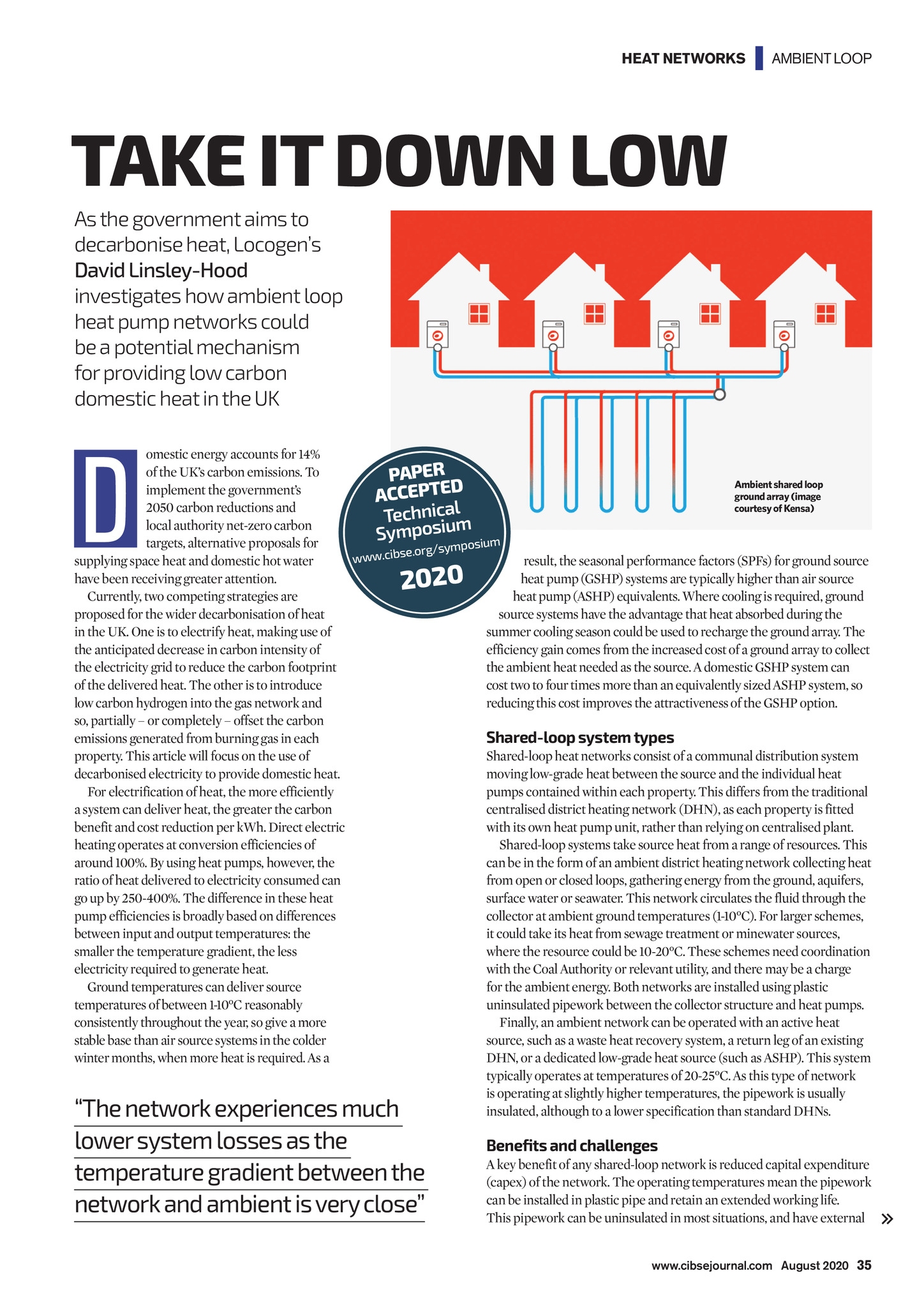
HEAT NETWORKS | AMBIENT LOOP TAKE IT DOWN LOW As the government aims to decarbonise heat, Locogens David Linsley-Hood investigates how ambient loop heat pump networks could be a potential mechanism for providing low carbon domestic heat in the UK D omestic energy accounts for 14% of the UKs carbon emissions. To PAPER Ambient shared loop implement the governments ground array (image ACCEPTED 2050 carbon reductions and courtesy of Kensa) l a ic n h Tec local authority net-zero carbon m Symposiu posium targets, alternative proposals for .org/sym www.cibse supplying space heat and domestic hot water result, the seasonal performance factors (SPFs) for ground source have been receiving greater attention. heat pump (GSHP) systems are typically higher than air source Currently, two competing strategies are heat pump (ASHP) equivalents. Where cooling is required, ground proposed for the wider decarbonisation of heat source systems have the advantage that heat absorbed during the in the UK. One is to electrify heat, making use of summer cooling season could be used to recharge the ground array. The the anticipated decrease in carbon intensity of efficiency gain comes from the increased cost of a ground array to collect the electricity grid to reduce the carbon footprint the ambient heat needed as the source. A domestic GSHP system can of the delivered heat. The other is to introduce cost two to four times more than an equivalently sized ASHP system, so low carbon hydrogen into the gas network and reducing this cost improves the attractiveness of the GSHP option. so, partially or completely offset the carbon emissions generated from burning gas in each Shared-loop system types property. This article will focus on the use of Shared-loop heat networks consist of a communal distribution system decarbonised electricity to provide domestic heat. moving low-grade heat between the source and the individual heat For electrification of heat, the more efficiently pumps contained within each property. This differs from the traditional a system can deliver heat, the greater the carbon centralised district heating network (DHN), as each property is fitted benefit and cost reduction per kWh. Direct electric with its own heat pump unit, rather than relying on centralised plant. heating operates at conversion efficiencies of Shared-loop systems take source heat from a range of resources. This around 100%. By using heat pumps, however, the can be in the form of an ambient district heating network collecting heat ratio of heat delivered to electricity consumed can from open or closed loops, gathering energy from the ground, aquifers, go up by 250-400%. The difference in these heat surface water or seawater. This network circulates the fluid through the pump efficiencies is broadly based on differences collector at ambient ground temperatures (1-10C). For larger schemes, between input and output temperatures: the it could take its heat from sewage treatment or minewater sources, smaller the temperature gradient, the less where the resource could be 10-20C. These schemes need coordination electricity required to generate heat. with the Coal Authority or relevant utility, and there may be a charge Ground temperatures can deliver source for the ambient energy. Both networks are installed using plastic temperatures of between 1-10C reasonably uninsulated pipework between the collector structure and heat pumps. consistently throughout the year, so give a more Finally, an ambient network can be operated with an active heat stable base than air source systems in the colder source, such as a waste heat recovery system, a return leg of an existing winter months, when more heat is required. As a DHN, or a dedicated low-grade heat source (such as ASHP). This system typically operates at temperatures of 20-25C. As this type of network is operating at slightly higher temperatures, the pipework is usually insulated, although to a lower specification than standard DHNs. 2020 The network experiences much lower system losses as the temperature gradient between the network and ambient is very close Benefits and challenges A key benefit of any shared-loop network is reduced capital expenditure (capex) of the network. The operating temperatures mean the pipework can be installed in plastic pipe and retain an extended working life. This pipework can be uninsulated in most situations, and have external www.cibsejournal.com August 2020 35 CIBSE Aug2020 p35-36 Tech symp networks.indd 35 24/07/2020 15:57