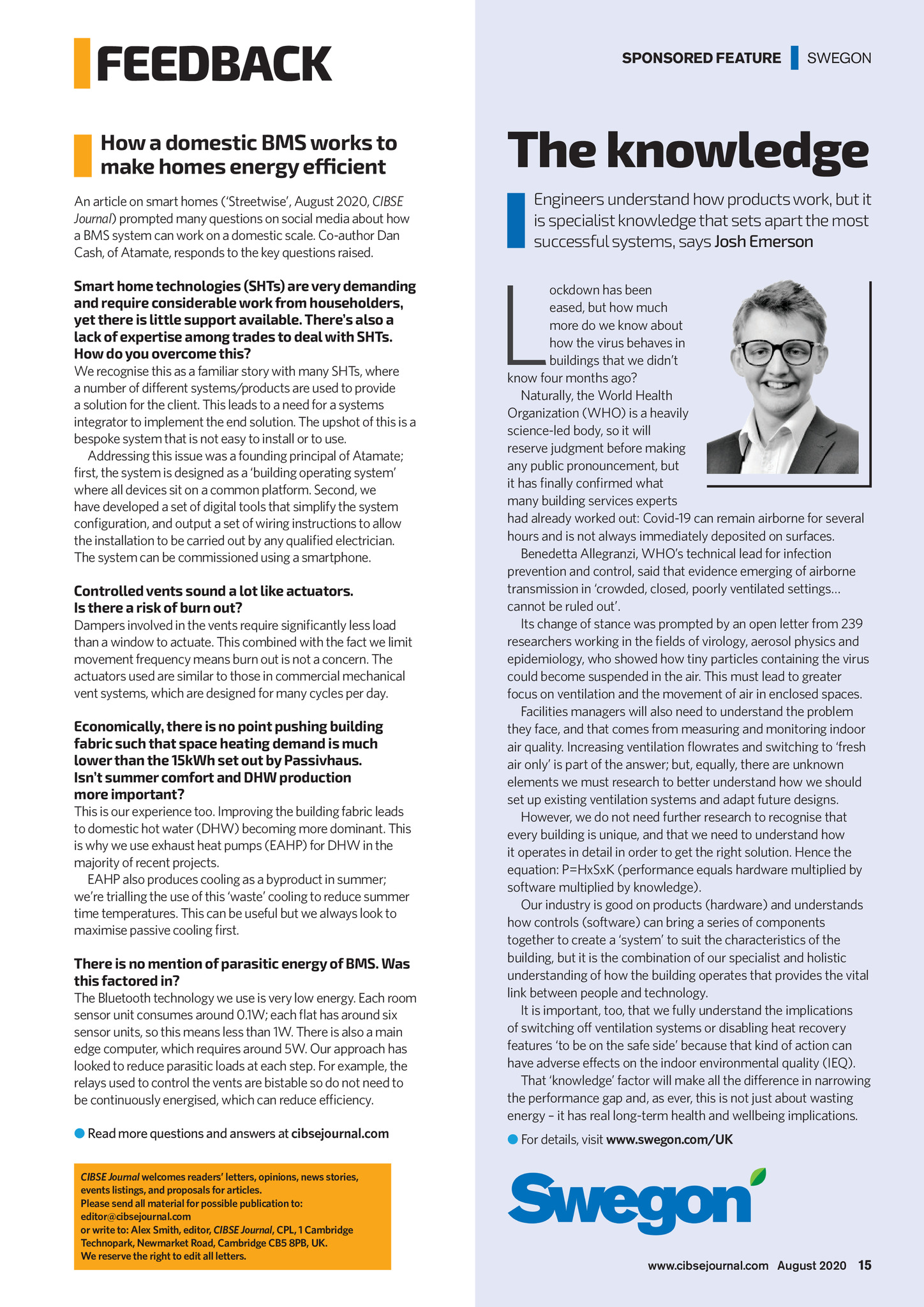
FEEDBACK How a domestic BMS works to make homes energy efficient An article on smart homes (Streetwise, August 2020, CIBSE Journal) prompted many questions on social media about how a BMS system can work on a domestic scale. Co-author Dan Cash, of Atamate, responds to the key questions raised. Smart home technologies (SHTs) are very demanding and require considerable work from householders, yet there is little support available. Theres also a lack of expertise among trades to deal with SHTs. How do you overcome this? We recognise this as a familiar story with many SHTs, where a number of different systems/products are used to provide a solution for the client. This leads to a need for a systems integrator to implement the end solution. The upshot of this is a bespoke system that is not easy to install or to use. Addressing this issue was a founding principal of Atamate; first, the system is designed as a building operating system where all devices sit on a common platform. Second, we have developed a set of digital tools that simplify the system configuration, and output a set of wiring instructions to allow the installation to be carried out by any qualified electrician. The system can be commissioned using a smartphone. Controlled vents sound a lot like actuators. Is there a risk of burn out? Dampers involved in the vents require significantly less load than a window to actuate. This combined with the fact we limit movement frequency means burn out is not a concern. The actuators used are similar to those in commercial mechanical vent systems, which are designed for many cycles per day. Economically, there is no point pushing building fabric such that space heating demand is much lower than the 15kWh set out by Passivhaus. Isnt summer comfort and DHW production more important? This is our experience too. Improving the building fabric leads to domestic hot water (DHW) becoming more dominant. This is why we use exhaust heat pumps (EAHP) for DHW in the majority of recent projects. EAHP also produces cooling as a byproduct in summer; were trialling the use of this waste cooling to reduce summer time temperatures. This can be useful but we always look to maximise passive cooling first. There is no mention of parasitic energy of BMS. Was this factored in? The Bluetooth technology we use is very low energy. Each room sensor unit consumes around 0.1W; each flat has around six sensor units, so this means less than 1W. There is also a main edge computer, which requires around 5W. Our approach has looked to reduce parasitic loads at each step. For example, the relays used to control the vents are bistable so do not need to be continuously energised, which can reduce efficiency. lR ead more questions and answers at cibsejournal.com CIBSE Journal welcomes readers letters, opinions, news stories, events listings, and proposals for articles. Please send all material for possible publication to: editor@cibsejournal.com or write to: Alex Smith, editor, CIBSE Journal, CPL, 1 Cambridge Technopark, Newmarket Road, Cambridge CB5 8PB, UK. We reserve the right to edit all letters. CIBSE August 2020 p15 Feedback Partron.indd 15 SPONSORED FEATURE | SWEGON The knowledge Engineers understand how products work, but it is specialist knowledge that sets apart the most successful systems, says Josh Emerson L ockdown has been eased, but how much more do we know about how the virus behaves in buildings that we didnt know four months ago? Naturally, the World Health Organization (WHO) is a heavily science-led body, so it will reserve judgment before making any public pronouncement, but it has finally confirmed what many building services experts had already worked out: Covid-19 can remain airborne for several hours and is not always immediately deposited on surfaces. Benedetta Allegranzi, WHOs technical lead for infection prevention and control, said that evidence emerging of airborne transmission in crowded, closed, poorly ventilated settings cannot be ruled out. Its change of stance was prompted by an open letter from 239 researchers working in the fields of virology, aerosol physics and epidemiology, who showed how tiny particles containing the virus could become suspended in the air. This must lead to greater focus on ventilation and the movement of air in enclosed spaces. Facilities managers will also need to understand the problem they face, and that comes from measuring and monitoring indoor air quality. Increasing ventilation flowrates and switching to fresh air only is part of the answer; but, equally, there are unknown elements we must research to better understand how we should set up existing ventilation systems and adapt future designs. However, we do not need further research to recognise that every building is unique, and that we need to understand how it operates in detail in order to get the right solution. Hence the equation: P=HxSxK (performance equals hardware multiplied by software multiplied by knowledge). Our industry is good on products (hardware) and understands how controls (software) can bring a series of components together to create a system to suit the characteristics of the building, but it is the combination of our specialist and holistic understanding of how the building operates that provides the vital link between people and technology. It is important, too, that we fully understand the implications of switching off ventilation systems or disabling heat recovery features to be on the safe side because that kind of action can have adverse effects on the indoor environmental quality (IEQ). That knowledge factor will make all the difference in narrowing the performance gap and, as ever, this is not just about wasting energy it has real long-term health and wellbeing implications. l For details, visit www.swegon.com/UK www.cibsejournal.com August 2020 15 24/07/2020 17:33