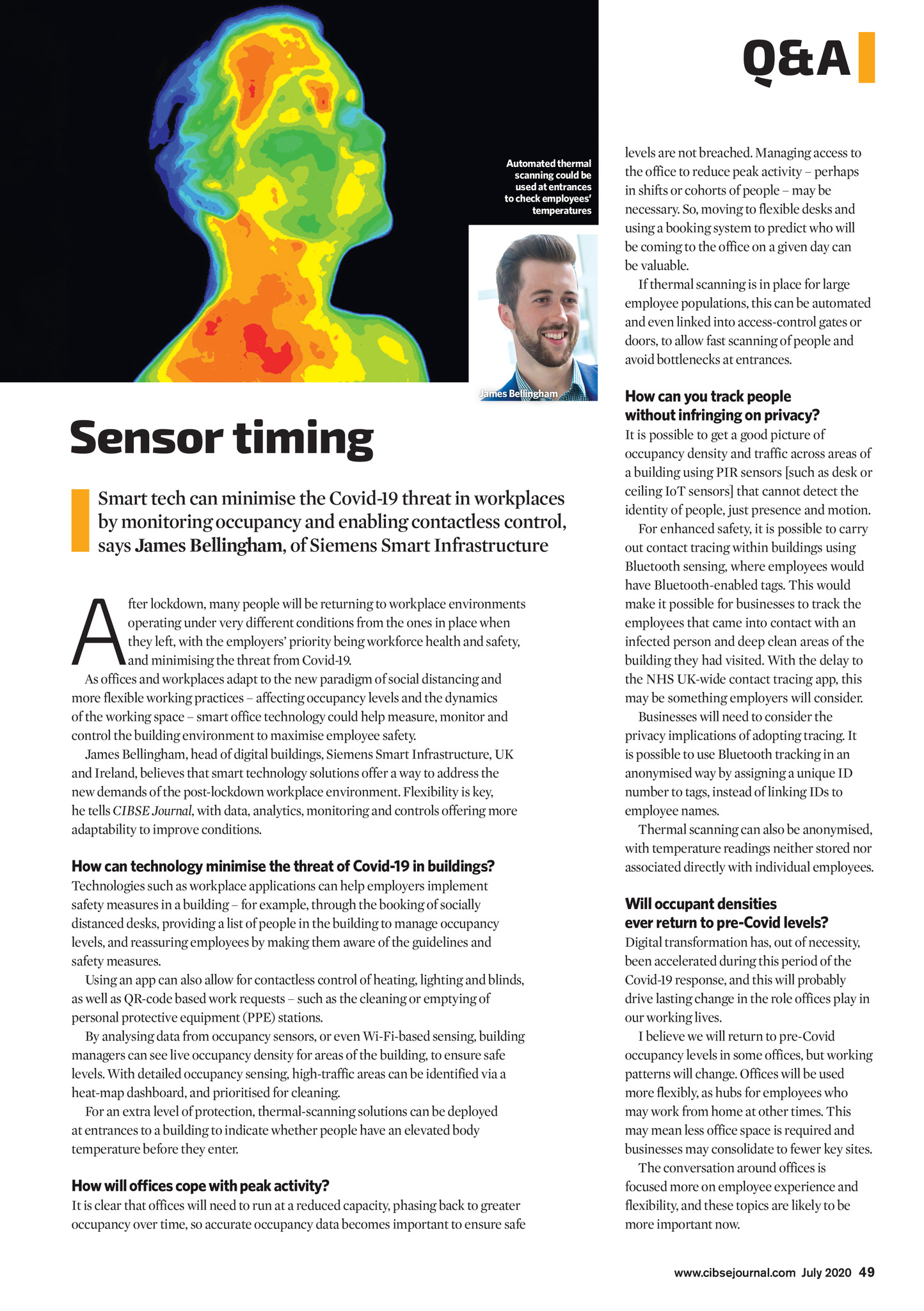
Q&A Automated thermal scanning could be used at entrances to check employees temperatures James Bellingham Sensor timing Smart tech can minimise the Covid-19 threat in workplaces by monitoring occupancy and enabling contactless control, says James Bellingham, of Siemens Smart Infrastructure A fter lockdown, many people will be returning to workplace environments operating under very different conditions from the ones in place when they left, with the employers priority being workforce health and safety, and minimising the threat from Covid-19. As offices and workplaces adapt to the new paradigm of social distancing and more flexible working practices affecting occupancy levels and the dynamics of the working space smart office technology could help measure, monitor and control the building environment to maximise employee safety. James Bellingham, head of digital buildings, Siemens Smart Infrastructure, UK and Ireland, believes that smart technology solutions offer a way to address the new demands of the post-lockdown workplace environment. Flexibility is key, he tells CIBSE Journal, with data, analytics, monitoring and controls offering more adaptability to improve conditions. How can technology minimise the threat of Covid-19 in buildings? Technologies such as workplace applications can help employers implement safety measures in a building for example, through the booking of socially distanced desks, providing a list of people in the building to manage occupancy levels, and reassuring employees by making them aware of the guidelines and safety measures. Using an app can also allow for contactless control of heating, lighting and blinds, as well as QR-code based work requests such as the cleaning or emptying of personal protective equipment (PPE) stations. By analysing data from occupancy sensors, or even Wi-Fi-based sensing, building managers can see live occupancy density for areas of the building, to ensure safe levels. With detailed occupancy sensing, high-traffic areas can be identified via a heat-map dashboard, and prioritised for cleaning. For an extra level of protection, thermal-scanning solutions can be deployed at entrances to a building to indicate whether people have an elevated body temperature before they enter. How will offices cope with peak activity? It is clear that offices will need to run at a reduced capacity, phasing back to greater occupancy over time, so accurate occupancy data becomes important to ensure safe levels are not breached. Managing access to the office to reduce peak activity perhaps in shifts or cohorts of people may be necessary. So, moving to flexible desks and using a booking system to predict who will be coming to the office on a given day can be valuable. If thermal scanning is in place for large employee populations, this can be automated and even linked into access-control gates or doors, to allow fast scanning of people and avoid bottlenecks at entrances. How can you track people without infringing on privacy? It is possible to get a good picture of occupancy density and traffic across areas of a building using PIR sensors [such as desk or ceiling IoT sensors] that cannot detect the identity of people, just presence and motion. For enhanced safety, it is possible to carry out contact tracing within buildings using Bluetooth sensing, where employees would have Bluetooth-enabled tags. This would make it possible for businesses to track the employees that came into contact with an infected person and deep clean areas of the building they had visited. With the delay to the NHS UK-wide contact tracing app, this may be something employers will consider. Businesses will need to consider the privacy implications of adopting tracing. It is possible to use Bluetooth tracking in an anonymised way by assigning a unique ID number to tags, instead of linking IDs to employee names. Thermal scanning can also be anonymised, with temperature readings neither stored nor associated directly with individual employees. Will occupant densities ever return to pre-Covid levels? Digital transformation has, out of necessity, been accelerated during this period of the Covid-19 response, and this will probably drive lasting change in the role offices play in our working lives. I believe we will return to pre-Covid occupancy levels in some offices, but working patterns will change. Offices will be used more flexibly, as hubs for employees who may work from home at other times. This may mean less office space is required and businesses may consolidate to fewer key sites. The conversation around offices is focused more on employee experience and flexibility, and these topics are likely to be more important now. www.cibsejournal.com July 2020 49 CIBSE July 2020 p49 Siemens QA.indd 49 19/06/2020 16:01