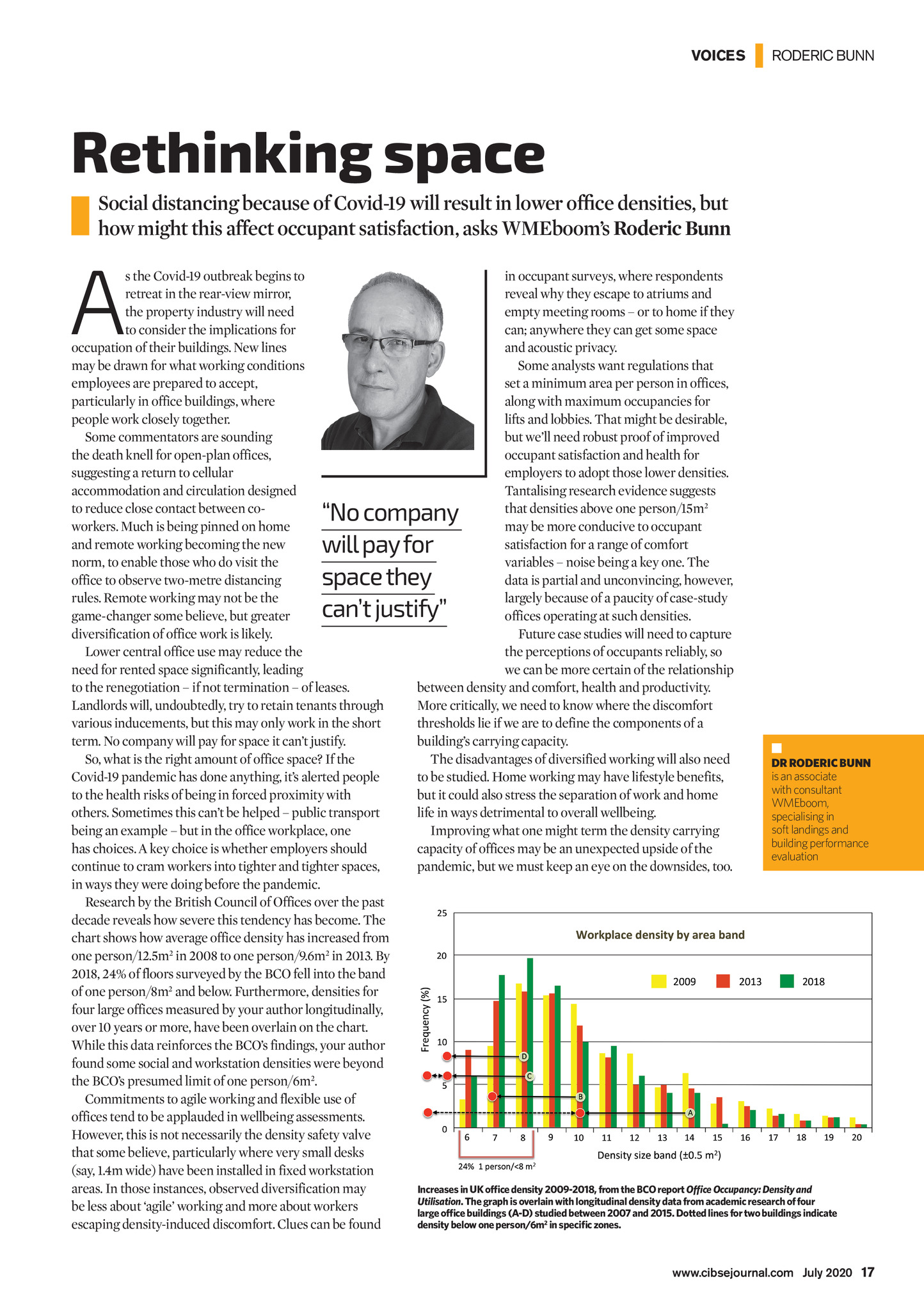
VOICES | RODERIC BUNN Rethinking space Social distancing because of Covid-19 will result in lower office densities, but how might this affect occupant satisfaction, asks WMEbooms Roderic Bunn A s the Covid-19 outbreak begins to retreat in the rear-view mirror, the property industry will need to consider the implications for occupation of their buildings. New lines may be drawn for what working conditions employees are prepared to accept, particularly in office buildings, where people work closely together. Some commentators are sounding the death knell for open-plan offices, suggesting a return to cellular accommodation and circulation designed to reduce close contact between coworkers. Much is being pinned on home and remote working becoming the new norm, to enable those who do visit the office to observe two-metre distancing rules. Remote working may not be the game-changer some believe, but greater diversification of office work is likely. Lower central office use may reduce the need for rented space significantly, leading to the renegotiation if not termination of leases. Landlords will, undoubtedly, try to retain tenants through various inducements, but this may only work in the short term. No company will pay for space it cant justify. So, what is the right amount of office space? If the Covid-19 pandemic has done anything, its alerted people to the health risks of being in forced proximity with others. Sometimes this cant be helped public transport being an example but in the office workplace, one has choices. A key choice is whether employers should continue to cram workers into tighter and tighter spaces, in ways they were doing before the pandemic. Research by the British Council of Offices over the past decade reveals how severe this tendency has become. The chart shows how average office density has increased from one person/12.5m2 in 2008 to one person/9.6m2 in 2013. By 2018, 24% of floors surveyed by the BCO fell into the band of one person/8m2 and below. Furthermore, densities for four large offices measured by your author longitudinally, over 10 years or more, have been overlain on the chart. While this data reinforces the BCOs findings, your author found some social and workstation densities were beyond the BCOs presumed limit of one person/6m2. Commitments to agile working and flexible use of offices tend to be applauded in wellbeing assessments. However, this is not necessarily the density safety valve that some believe, particularly where very small desks (say, 1.4m wide) have been installed in fixed workstation areas. In those instances, observed diversification may be less about agile working and more about workers escaping density-induced discomfort. Clues can be found in occupant surveys, where respondents reveal why they escape to atriums and empty meeting rooms or to home if they can; anywhere they can get some space and acoustic privacy. Some analysts want regulations that set a minimum area per person in offices, along with maximum occupancies for lifts and lobbies. That might be desirable, but well need robust proof of improved occupant satisfaction and health for employers to adopt those lower densities. Tantalising research evidence suggests that densities above one person/15m2 may be more conducive to occupant satisfaction for a range of comfort variables noise being a key one. The data is partial and unconvincing, however, largely because of a paucity of case-study offices operating at such densities. Future case studies will need to capture the perceptions of occupants reliably, so we can be more certain of the relationship between density and comfort, health and productivity. More critically, we need to know where the discomfort thresholds lie if we are to define the components of a buildings carrying capacity. The disadvantages of diversified working will also need to be studied. Home working may have lifestyle benefits, but it could also stress the separation of work and home life in ways detrimental to overall wellbeing. Improving what one might term the density carrying capacity of offices may be an unexpected upside of the pandemic, but we must keep an eye on the downsides, too. No company will pay for space they cant justify DR RODERIC BUNN is an associate with consultant WMEboom, specialising in soft landings and building performance evaluation Increases in UK office density 2009-2018, from the BCO report Office Occupancy: Density and Utilisation. The graph is overlain with longitudinal density data from academic research of four large office buildings (A-D) studied between 2007 and 2015. Dotted lines for two buildings indicate density below one person/6m2 in specific zones. www.cibsejournal.com July 2020 17 CIBSE July 2020 p17 Rod Bunn.indd 17 19/06/2020 15:44