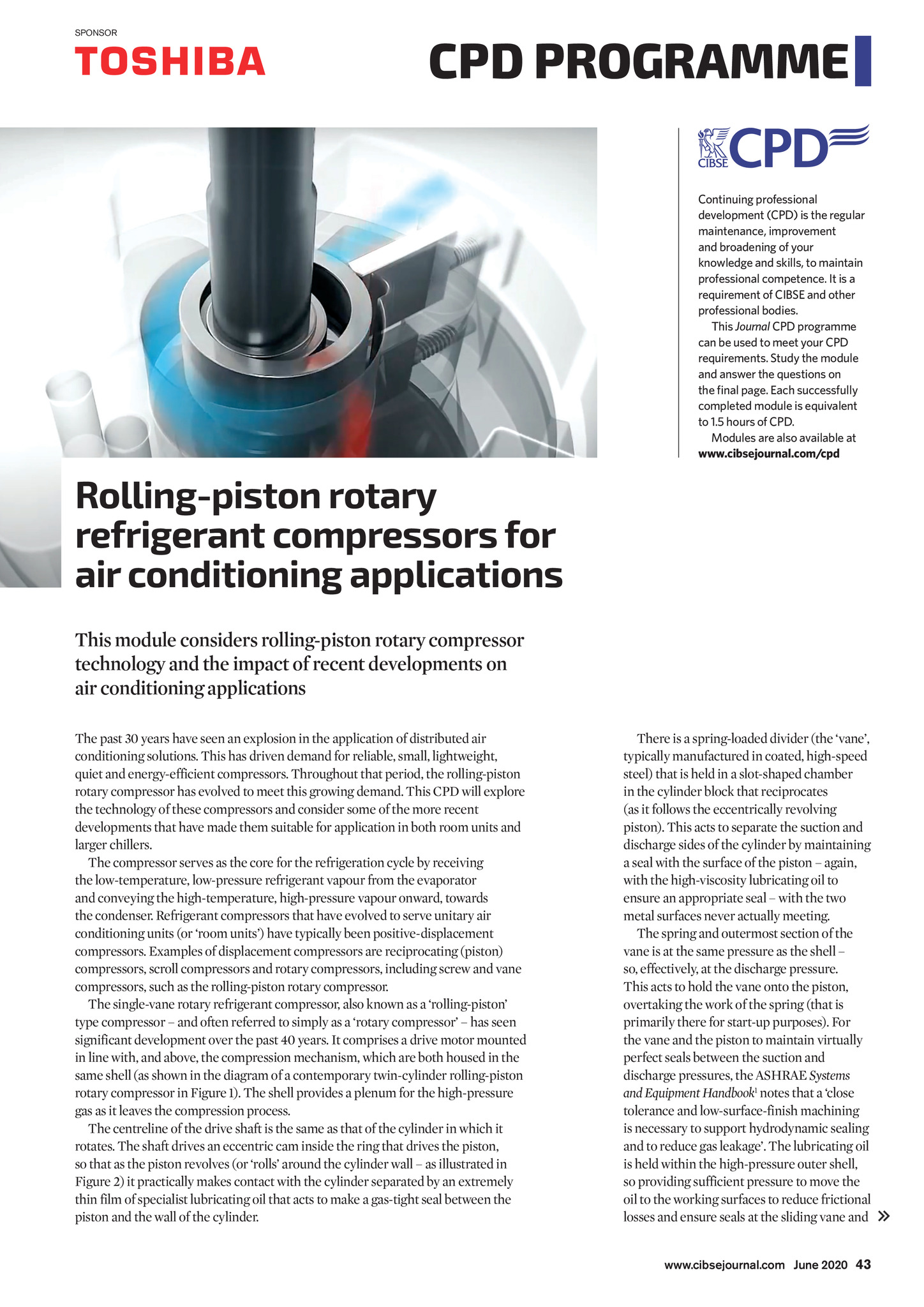
SPONSOR CPD PROGRAMME Continuing professional development (CPD) is the regular maintenance, improvement and broadening of your knowledge and skills, to maintain professional competence. It is a requirement of CIBSE and other professional bodies. This Journal CPD programme can be used to meet your CPD requirements. Study the module and answer the questions on the final page. Each successfully completed module is equivalent to 1.5 hours of CPD. Modules are also available at www.cibsejournal.com/cpd Rolling-piston rotary refrigerant compressors for air conditioning applications This module considers rolling-piston rotary compressor technology and the impact of recent developments on air conditioning applications The past 30 years have seen an explosion in the application of distributed air conditioning solutions. This has driven demand for reliable, small, lightweight, quiet and energy-efficient compressors. Throughout that period, the rolling-piston rotary compressor has evolved to meet this growing demand. This CPD will explore the technology of these compressors and consider some of the more recent developments that have made them suitable for application in both room units and larger chillers. The compressor serves as the core for the refrigeration cycle by receiving the low-temperature, low-pressure refrigerant vapour from the evaporator and conveying the high-temperature, high-pressure vapour onward, towards the condenser. Refrigerant compressors that have evolved to serve unitary air conditioning units (or room units) have typically been positive-displacement compressors. Examples of displacement compressors are reciprocating (piston) compressors, scroll compressors and rotary compressors, including screw and vane compressors, such as the rolling-piston rotary compressor. The single-vane rotary refrigerant compressor, also known as a rolling-piston type compressor and often referred to simply as a rotary compressor has seen significant development over the past 40 years. It comprises a drive motor mounted in line with, and above, the compression mechanism, which are both housed in the same shell (as shown in the diagram of a contemporary twin-cylinder rolling-piston rotary compressor in Figure 1). The shell provides a plenum for the high-pressure gas as it leaves the compression process. The centreline of the drive shaft is the same as that of the cylinder in which it rotates. The shaft drives an eccentric cam inside the ring that drives the piston, so that as the piston revolves (or rolls around the cylinder wall as illustrated in Figure 2) it practically makes contact with the cylinder separated by an extremely thin film of specialist lubricating oil that acts to make a gas-tight seal between the piston and the wall of the cylinder. There is a spring-loaded divider (the vane, typically manufactured in coated, high-speed steel) that is held in a slot-shaped chamber in the cylinder block that reciprocates (as it follows the eccentrically revolving piston). This acts to separate the suction and discharge sides of the cylinder by maintaining a seal with the surface of the piston again, with the high-viscosity lubricating oil to ensure an appropriate seal with the two metal surfaces never actually meeting. The spring and outermost section of the vane is at the same pressure as the shell so, effectively, at the discharge pressure. This acts to hold the vane onto the piston, overtaking the work of the spring (that is primarily there for start-up purposes). For the vane and the piston to maintain virtually perfect seals between the suction and discharge pressures, the ASHRAE Systems and Equipment Handbook1 notes that a close tolerance and low-surface-finish machining is necessary to support hydrodynamic sealing and to reduce gas leakage. The lubricating oil is held within the high-pressure outer shell, so providing sufficient pressure to move the oil to the working surfaces to reduce frictional losses and ensure seals at the sliding vane and www.cibsejournal.com June 2020 43 CIBSE June 2020 p43-46 CPD Toshiba 163 v2.indd 43 22/05/2020 17:45