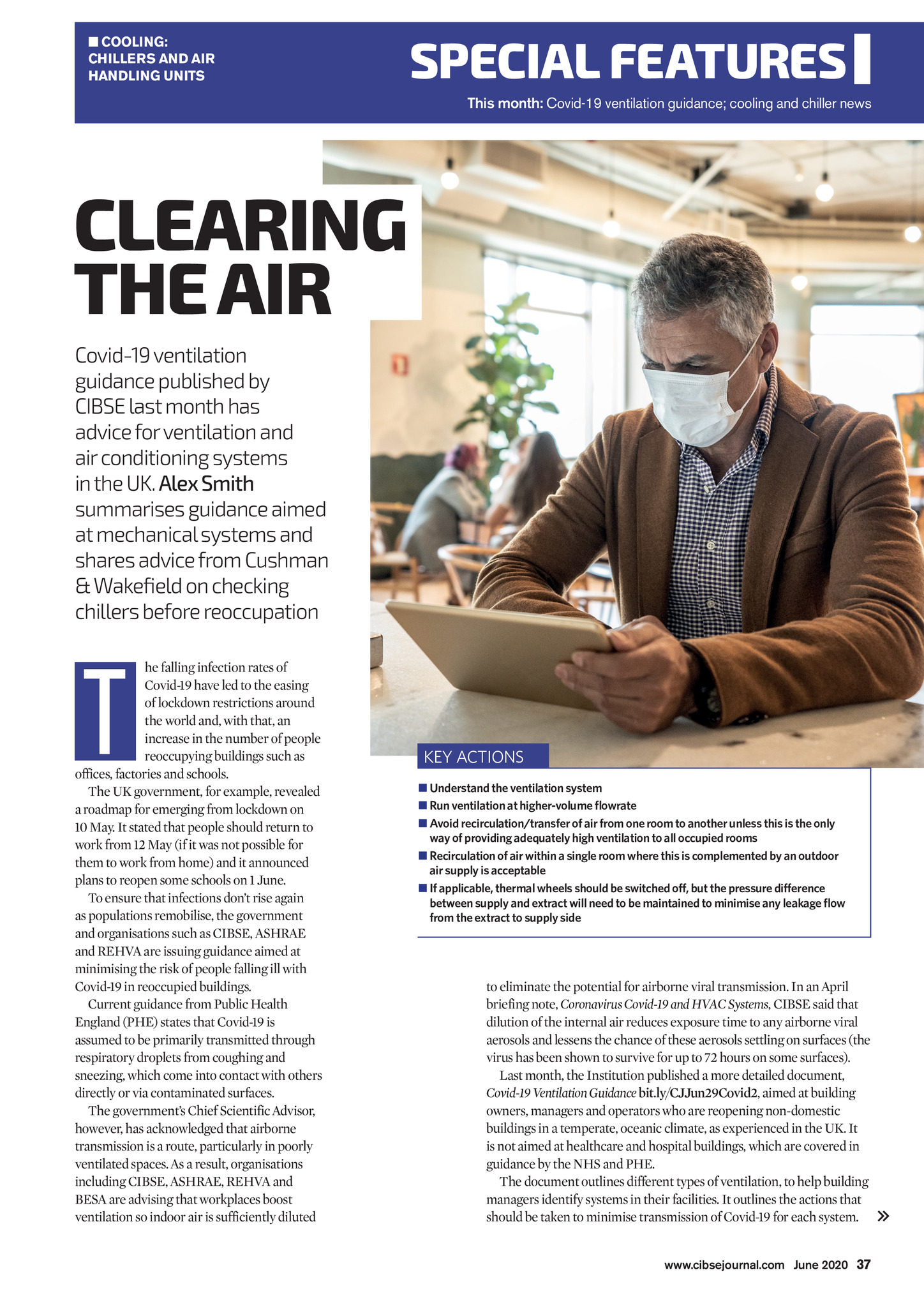
COOLING: CHILLERS AND AIR HANDLING UNITS SPECIAL FEATURES This month: Covid-19 ventilation guidance; cooling and chiller news CLEARING THE AIR Covid-19 ventilation guidance published by CIBSE last month has advice for ventilation and air conditioning systems in the UK. Alex Smith summarises guidance aimed at mechanical systems and shares advice from Cushman & Wakefield on checking chillers before reoccupation T he falling infection rates of Covid-19 have led to the easing of lockdown restrictions around the world and, with that, an increase in the number of people reoccupying buildings such as offices, factories and schools. The UK government, for example, revealed a roadmap for emerging from lockdown on 10 May. It stated that people should return to work from 12 May (if it was not possible for them to work from home) and it announced plans to reopen some schools on 1 June. To ensure that infections dont rise again as populations remobilise, the government and organisations such as CIBSE, ASHRAE and REHVA are issuing guidance aimed at minimising the risk of people falling ill with Covid-19 in reoccupied buildings. Current guidance from Public Health England (PHE) states that Covid-19 is assumed to be primarily transmitted through respiratory droplets from coughing and sneezing, which come into contact with others directly or via contaminated surfaces. The governments Chief Scientific Advisor, however, has acknowledged that airborne transmission is a route, particularly in poorly ventilated spaces. As a result, organisations including CIBSE, ASHRAE, REHVA and BESA are advising that workplaces boost ventilation so indoor air is sufficiently diluted KEY ACTIONS n Understand the ventilation system n Run ventilation at higher-volume flowrate n Avoid recirculation/transfer of air from one room to another unless this is the only way of providing adequately high ventilation to all occupied rooms n Recirculation of air within a single room where this is complemented by an outdoor air supply is acceptable n If applicable, thermal wheels should be switched off, but the pressure difference between supply and extract will need to be maintained to minimise any leakage flow from the extract to supply side to eliminate the potential for airborne viral transmission. In an April briefing note, Coronavirus Covid-19 and HVAC Systems, CIBSE said that dilution of the internal air reduces exposure time to any airborne viral aerosols and lessens the chance of these aerosols settling on surfaces (the virus has been shown to survive for up to 72 hours on some surfaces). Last month, the Institution published a more detailed document, Covid-19 Ventilation Guidance bit.ly/CJJun29Covid2, aimed at building owners, managers and operators who are reopening non-domestic buildings in a temperate, oceanic climate, as experienced in the UK. It is not aimed at healthcare and hospital buildings, which are covered in guidance by the NHS and PHE. The document outlines different types of ventilation, to help building managers identify systems in their facilities. It outlines the actions that should be taken to minimise transmission of Covid-19 for each system. www.cibsejournal.com June 2020 37 CIBSE June 2020 pp37-39 Covid aircon.indd 37 22/05/2020 19:34