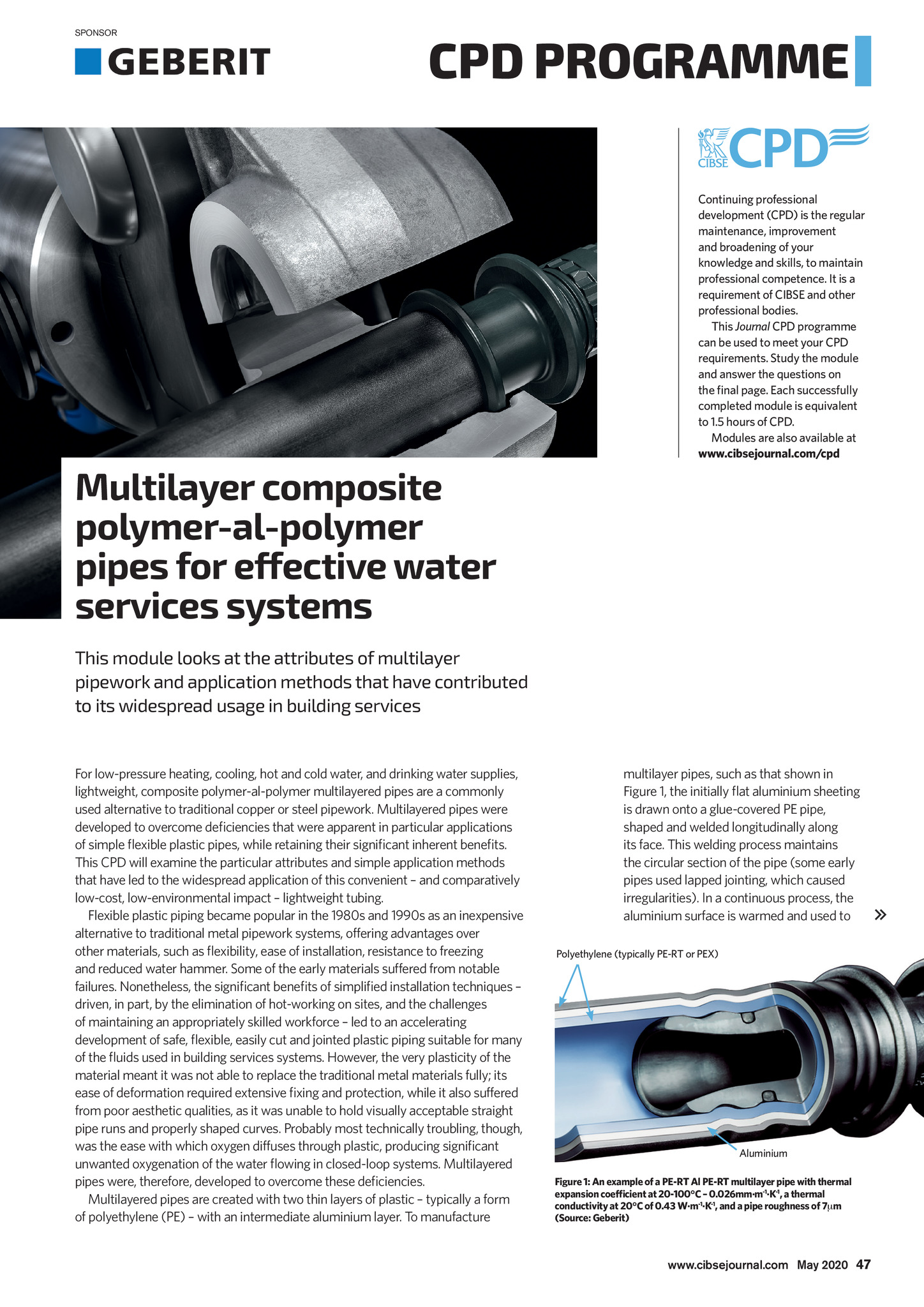
SPONSOR CPD PROGRAMME Continuing professional development (CPD) is the regular maintenance, improvement and broadening of your knowledge and skills, to maintain professional competence. It is a requirement of CIBSE and other professional bodies. This Journal CPD programme can be used to meet your CPD requirements. Study the module and answer the questions on the final page. Each successfully completed module is equivalent to 1.5 hours of CPD. Modules are also available at www.cibsejournal.com/cpd Multilayer composite polymer-al-polymer pipes for effective water services systems This module looks at the attributes of multilayer pipework and application methods that have contributed to its widespread usage in building services For low-pressure heating, cooling, hot and cold water, and drinking water supplies, lightweight, composite polymer-al-polymer multilayered pipes are a commonly used alternative to traditional copper or steel pipework. Multilayered pipes were developed to overcome deficiencies that were apparent in particular applications of simple flexible plastic pipes, while retaining their significant inherent benefits. This CPD will examine the particular attributes and simple application methods that have led to the widespread application of this convenient and comparatively low-cost, low-environmental impact lightweight tubing. Flexible plastic piping became popular in the 1980s and 1990s as an inexpensive alternative to traditional metal pipework systems, offering advantages over other materials, such as flexibility, ease of installation, resistance to freezing and reduced water hammer. Some of the early materials suffered from notable failures. Nonetheless, the significant benefits of simplified installation techniques driven, in part, by the elimination of hot-working on sites, and the challenges of maintaining an appropriately skilled workforce led to an accelerating development of safe, flexible, easily cut and jointed plastic piping suitable for many of the fluids used in building services systems. However, the very plasticity of the material meant it was not able to replace the traditional metal materials fully; its ease of deformation required extensive fixing and protection, while it also suffered from poor aesthetic qualities, as it was unable to hold visually acceptable straight pipe runs and properly shaped curves. Probably most technically troubling, though, was the ease with which oxygen diffuses through plastic, producing significant unwanted oxygenation of the water flowing in closed-loop systems. Multilayered pipes were, therefore, developed to overcome these deficiencies. Multilayered pipes are created with two thin layers of plastic typically a form of polyethylene (PE) with an intermediate aluminium layer. To manufacture multilayer pipes, such as that shown in Figure 1, the initially flat aluminium sheeting is drawn onto a glue-covered PE pipe, shaped and welded longitudinally along its face. This welding process maintains the circular section of the pipe (some early pipes used lapped jointing, which caused irregularities). In a continuous process, the aluminium surface is warmed and used to Polyethylene (typically PE-RT or PEX) Aluminium Figure 1: An example of a PE-RT Al PE-RT multilayer pipe with thermal expansion coefficient at 20-100C 0.026mmm-1K-1, a thermal conductivity at 20C of 0.43 Wm-1K-1, and a pipe roughness of 7m (Source: Geberit) www.cibsejournal.com May 2020 47 CIBSE May 20 pp47-50 CPD Geberit v2.indd 47 24/04/2020 16:35