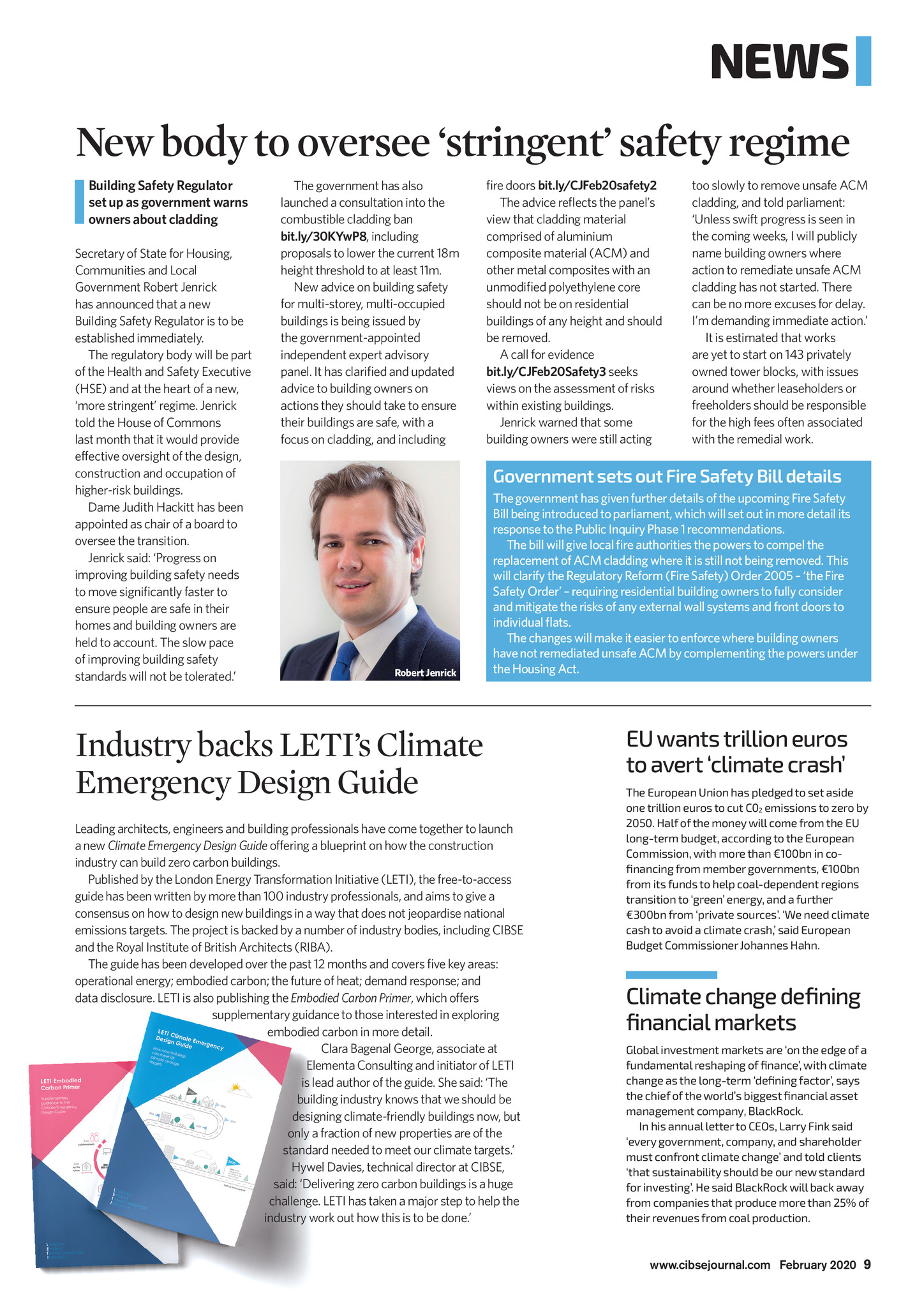

EWS New body to oversee stringent safety regime Building Safety Regulator set up as government warns owners about cladding Secretary of State for Housing, Communities and Local Government Robert Jenrick has announced that a new Building Safety Regulator is to be established immediately. The regulatory body will be part of the Health and Safety Executive (HSE) and at the heart of a new, more stringent regime. Jenrick told the House of Commons last month that it would provide effective oversight of the design, construction and occupation of higher-risk buildings. Dame Judith Hackitt has been appointed as chair of a board to oversee the transition. Jenrick said: Progress on improving building safety needs to move signicantly faster to ensure people are safe in their homes and building owners are held to account. The slow pace of improving building safety standards will not be tolerated. The government has also launched a consultation into the combustible cladding ban bit.ly/30KYwP8, including proposals to lower the current 18m height threshold to at least 11m. New advice on building safety for multi-storey, multi-occupied buildings is being issued by the government-appointed independent expert advisory panel. It has claried and updated advice to building owners on actions they should take to ensure their buildings are safe, with a focus on cladding, and including re doors bit.ly/CJFeb20safety2 The advice reects the panels view that cladding material comprised of aluminium composite material (ACM) and other metal composites with an unmodied polyethylene core should not be on residential buildings of any height and should be removed. A call for evidence bit.ly/CJFeb20Safety3 seeks views on the assessment of risks within existing buildings. Jenrick warned that some building owners were still acting too slowly to remove unsafe ACM cladding, and told parliament: Unless swift progress is seen in the coming weeks, I will publicly name building owners where action to remediate unsafe ACM cladding has not started. There can be no more excuses for delay. Im demanding immediate action. It is estimated that works are yet to start on 143 privately owned tower blocks, with issues around whether leaseholders or freeholders should be responsible for the high fees often associated with the remedial work. Government sets out Fire Safety Bill details Robert Jenrick The government has given further details of the upcoming Fire Safety Bill being introduced to parliament, which will set out in more detail its response to the Public Inquiry Phase 1 recommendations. The bill will give local re authorities the powers to compel the replacement of ACM cladding where it is still not being removed. This will clarify the Regulatory Reform (Fire Safety) Order 2005 the Fire Safety Order requiring residential building owners to fully consider and mitigate the risks of any external wall systems and front doors to individual ats. The changes will make it easier to enforce where building owners have not remediated unsafe ACM by complementing the powers under the Housing Act. Industry backs LETIs Climate Emergency Design Guide Leading architects, engineers and building professionals have come together to launch a new Climate Emergency Design Guide offering a blueprint on how the construction industry can build zero carbon buildings. Published by the London Energy Transformation Initiative (LETI), the free-to-access guide has been written by more than 100 industry professionals, and aims to give a consensus on how to design new buildings in a way that does not jeopardise national emissions targets. The project is backed by a number of industry bodies, including CIBSE and the Royal Institute of British Architects (RIBA). The guide has been developed over the past 12 months and covers ve key areas: operational energy; embodied carbon; the future of heat; demand response; and data disclosure. LETI is also publishing the Embodied Carbon Primer, which offers supplementary guidance to those interested in exploring embodied carbon in more detail. Clara Bagenal George, associate at Elementa Consulting and initiator of LETI is lead author of the guide. She said: The building industry knows that we should be designing climate-friendly buildings now, but only a fraction of new properties are of the standard needed to meet our climate targets. Hywel Davies, technical director at CIBSE, said: Delivering zero carbon buildings is a huge challenge. LETI has taken a major step to help the industry work out how this is to be done. EU wants trillion euros to avert climate crash The European Union has pledged to set aside one trillion euros to cut C02 emissions to zero by 2050. Half of the money will come from the EU long-term budget, according to the European Commission, with more than 100bn in cofinancing from member governments, 100bn from its funds to help coal-dependent regions transition to green energy, and a further 300bn from private sources. We need climate cash to avoid a climate crash, said European Budget Commissioner Johannes Hahn. Climate change defining financial markets Global investment markets are on the edge of a fundamental reshaping of finance, with climate change as the long-term defining factor, says the chief of the worlds biggest financial asset management company, BlackRock. In his annual letter to CEOs, Larry Fink said every government, company, and shareholder must confront climate change and told clients that sustainability should be our new standard for investing. He said BlackRock will back away from companies that produce more than 25% of their revenues from coal production. www.cibsejournal.com February 2020 9 CIBSE Feb20 pp09 News.indd 9 24/01/2020 14:42