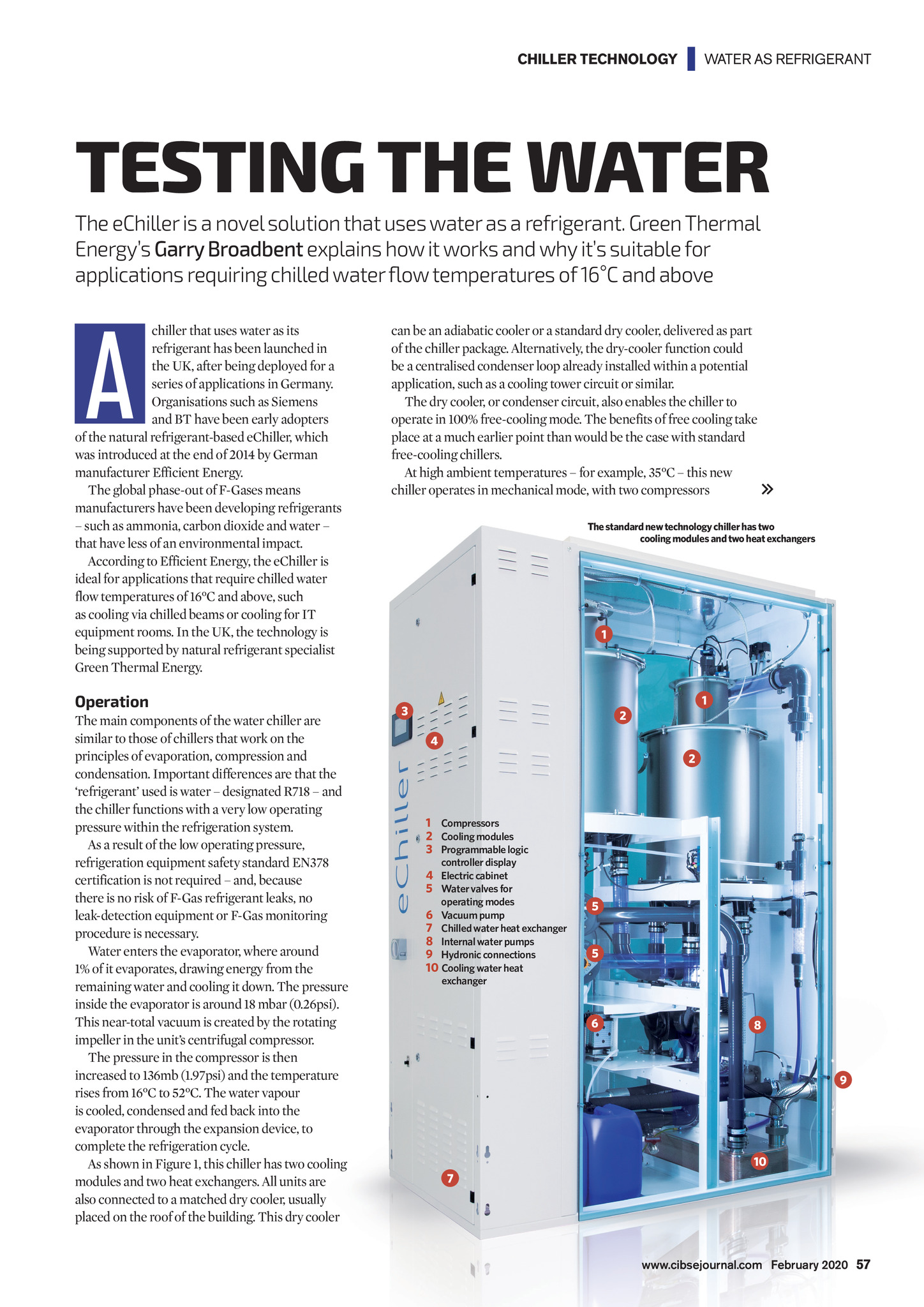
CHILLER TECHNOLOGY | WATER AS REFRIGERANT TESTING THE WATER The eChiller is a novel solution that uses water as a refrigerant. Green Thermal Energys Garry Broadbent explains how it works and why its suitable for applications requiring chilled water flow temperatures of 16C and above A chiller that uses water as its refrigerant has been launched in the UK, after being deployed for a series of applications in Germany. Organisations such as Siemens and BT have been early adopters of the natural refrigerant-based eChiller, which was introduced at the end of 2014 by German manufacturer Efficient Energy. The global phase-out of F-Gases means manufacturers have been developing refrigerants such as ammonia, carbon dioxide and water that have less of an environmental impact. According to Efficient Energy, the eChiller is ideal for applications that require chilled water flow temperatures of 16C and above, such as cooling via chilled beams or cooling for IT equipment rooms. In the UK, the technology is being supported by natural refrigerant specialist Green Thermal Energy. can be an adiabatic cooler or a standard dry cooler, delivered as part of the chiller package. Alternatively, the dry-cooler function could be a centralised condenser loop already installed within a potential application, such as a cooling tower circuit or similar. The dry cooler, or condenser circuit, also enables the chiller to operate in 100% free-cooling mode. The benefits of free cooling take place at a much earlier point than would be the case with standard free-cooling chillers. At high ambient temperatures for example, 35C this new chiller operates in mechanical mode, with two compressors The standard new technology chiller has two cooling modules and two heat exchangers Operation The main components of the water chiller are similar to those of chillers that work on the principles of evaporation, compression and condensation. Important differences are that the refrigerant used is water designated R718 and the chiller functions with a very low operating pressure within the refrigeration system. As a result of the low operating pressure, refrigeration equipment safety standard EN378 certification is not required and, because there is no risk of F-Gas refrigerant leaks, no leak-detection equipment or F-Gas monitoring procedure is necessary. Water enters the evaporator, where around 1% of it evaporates, drawing energy from the remaining water and cooling it down. The pressure inside the evaporator is around 18 mbar (0.26psi). This near-total vacuum is created by the rotating impeller in the units centrifugal compressor. The pressure in the compressor is then increased to 136mb (1.97psi) and the temperature rises from 16C to 52C. The water vapour is cooled, condensed and fed back into the evaporator through the expansion device, to complete the refrigeration cycle. As shown in Figure 1, this chiller has two cooling modules and two heat exchangers. All units are also connected to a matched dry cooler, usually placed on the roof of the building. This dry cooler 1 Compressors 2 Cooling modules 3 Programmable logic controller display 4 Electric cabinet 5 Water valves for operating modes 6 Vacuum pump 7 Chilled water heat exchanger 8 Internal water pumps 9 Hydronic connections 10 Cooling water heat exchanger www.cibsejournal.com February 2020 57 CIBSE Feb20 pp57-58 eChiller.indd 57 24/01/2020 15:10