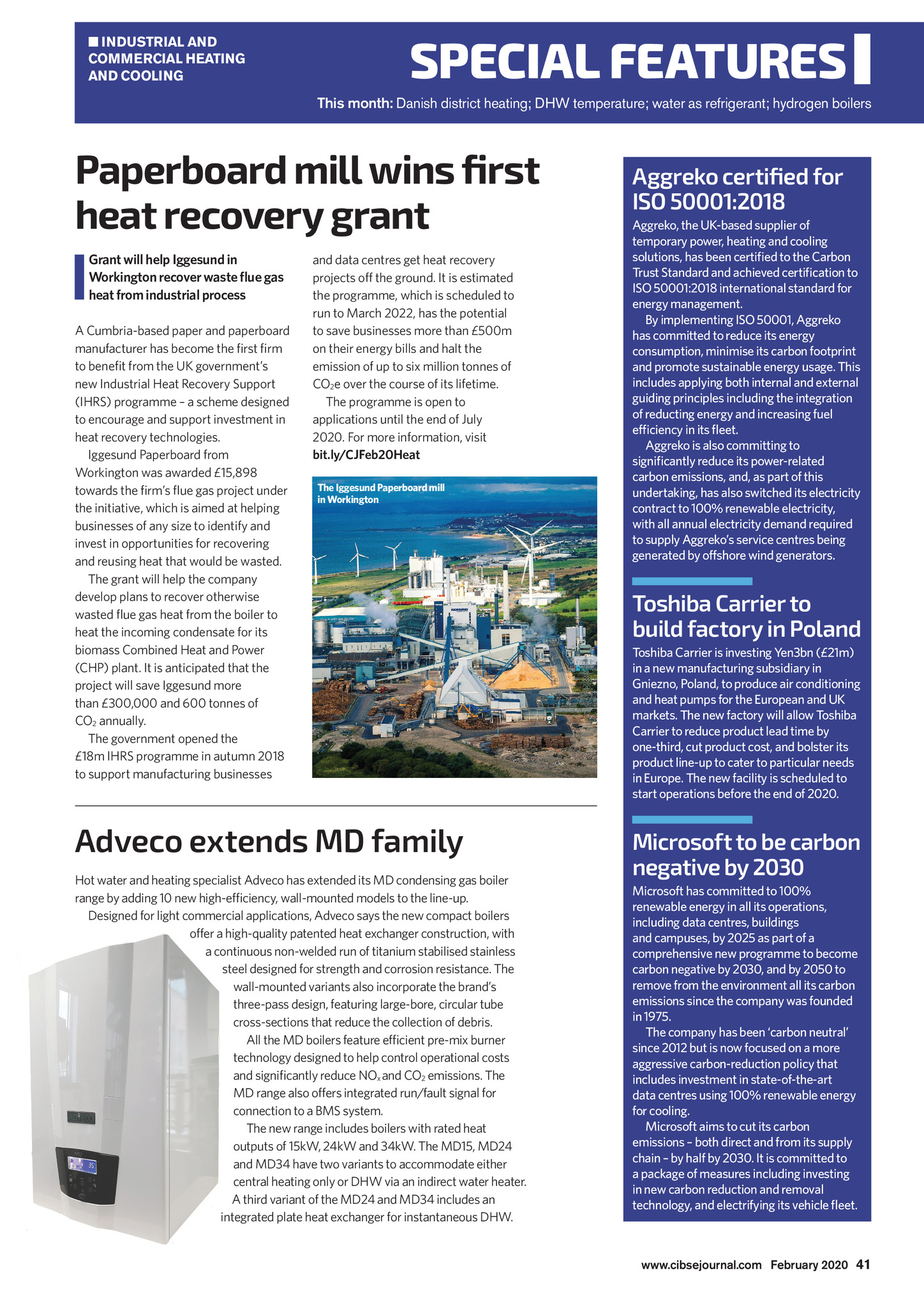
INDUSTRIAL AND COMMERCIAL HEATING AND COOLING SPECIAL FEATURES This month: Danish district heating; DHW temperature; water as refrigerant; hydrogen boilers Paperboard mill wins first heat recovery grant Grant will help Iggesund in Workington recover waste flue gas heat from industrial process A Cumbria-based paper and paperboard manufacturer has become the first firm to benefit from the UK governments new Industrial Heat Recovery Support (IHRS) programme a scheme designed to encourage and support investment in heat recovery technologies. Iggesund Paperboard from Workington was awarded 15,898 towards the firms flue gas project under the initiative, which is aimed at helping businesses of any size to identify and invest in opportunities for recovering and reusing heat that would be wasted. The grant will help the company develop plans to recover otherwise wasted flue gas heat from the boiler to heat the incoming condensate for its biomass Combined Heat and Power (CHP) plant. It is anticipated that the project will save Iggesund more than 300,000 and 600 tonnes of CO2 annually. The government opened the 18m IHRS programme in autumn 2018 to support manufacturing businesses and data centres get heat recovery projects off the ground. It is estimated the programme, which is scheduled to run to March 2022, has the potential to save businesses more than 500m on their energy bills and halt the emission of up to six million tonnes of CO2e over the course of its lifetime. The programme is open to applications until the end of July 2020. For more information, visit bit.ly/CJFeb20Heat The Iggesund Paperboard mill in Workington Adveco extends MD family Hot water and heating specialist Adveco has extended its MD condensing gas boiler range by adding 10 new high-efficiency, wall-mounted models to the line-up. Designed for light commercial applications, Adveco says the new compact boilers offer a high-quality patented heat exchanger construction, with a continuous non-welded run of titanium stabilised stainless steel designed for strength and corrosion resistance. The wall-mounted variants also incorporate the brands three-pass design, featuring large-bore, circular tube cross-sections that reduce the collection of debris. All the MD boilers feature efficient pre-mix burner technology designed to help control operational costs and significantly reduce NOx and CO2 emissions. The MD range also offers integrated run/fault signal for connection to a BMS system. The new range includes boilers with rated heat outputs of 15kW, 24kW and 34kW. The MD15, MD24 and MD34 have two variants to accommodate either central heating only or DHW via an indirect water heater. A third variant of the MD24 and MD34 includes an integrated plate heat exchanger for instantaneous DHW. Aggreko certified for ISO 50001:2018 Aggreko, the UK-based supplier of temporary power, heating and cooling solutions, has been certified to the Carbon Trust Standard and achieved certification to ISO 50001:2018 international standard for energy management. By implementing ISO 50001, Aggreko has committed to reduce its energy consumption, minimise its carbon footprint and promote sustainable energy usage. This includes applying both internal and external guiding principles including the integration of reducting energy and increasing fuel efficiency in its fleet. Aggreko is also committing to significantly reduce its power-related carbon emissions, and, as part of this undertaking, has also switched its electricity contract to 100% renewable electricity, with all annual electricity demand required to supply Aggrekos service centres being generated by offshore wind generators. Toshiba Carrier to build factory in Poland Toshiba Carrier is investing Yen3bn (21m) in a new manufacturing subsidiary in Gniezno, Poland, to produce air conditioning and heat pumps for the European and UK markets. The new factory will allow Toshiba Carrier to reduce product lead time by one-third, cut product cost, and bolster its product line-up to cater to particular needs in Europe. The new facility is scheduled to start operations before the end of 2020. Microsoft to be carbon negative by 2030 Microsoft has committed to 100% renewable energy in all its operations, including data centres, buildings and campuses, by 2025 as part of a comprehensive new programme to become carbon negative by 2030, and by 2050 to remove from the environment all its carbon emissions since the company was founded in 1975. The company has been carbon neutral since 2012 but is now focused on a more aggressive carbon-reduction policy that includes investment in state-of-the-art data centres using 100% renewable energy for cooling. Microsoft aims to cut its carbon emissions both direct and from its supply chain by half by 2030. It is committed to a package of measures including investing in new carbon reduction and removal technology, and electrifying its vehicle fleet. www.cibsejournal.com February 2020 41 CIBSE Feb20 pp41 CoolHeat News.indd 41 24/01/2020 15:07