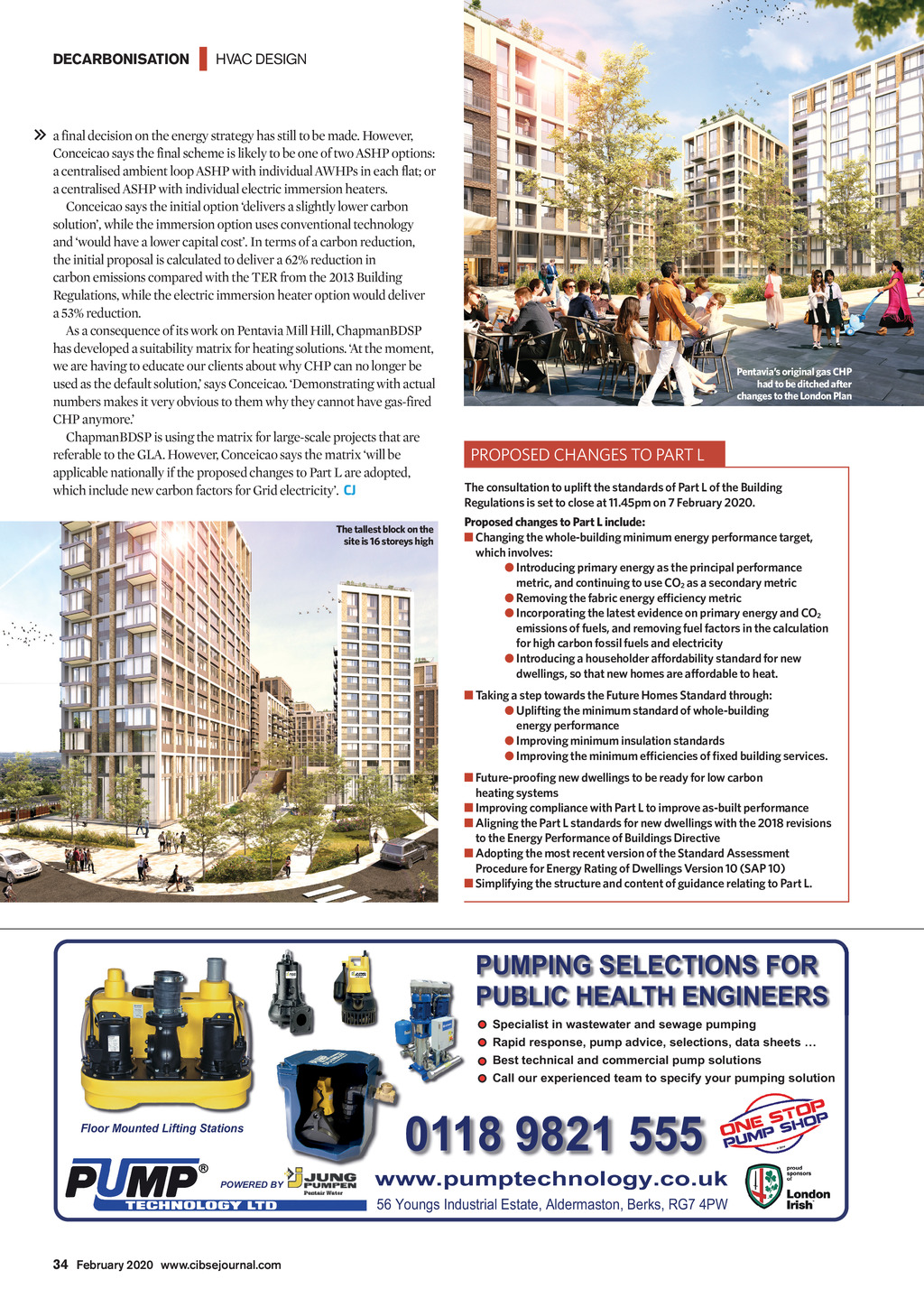


DECARBONISATION | HVAC DESIGN a final decision on the energy strategy has still to be made. However, Conceicao says the final scheme is likely to be one of two ASHP options: a centralised ambient loop ASHP with individual AWHPs in each flat; or a centralised ASHP with individual electric immersion heaters. Conceicao says the initial option delivers a slightly lower carbon solution, while the immersion option uses conventional technology and would have a lower capital cost. In terms of a carbon reduction, the initial proposal is calculated to deliver a 62% reduction in carbon emissions compared with the TER from the 2013 Building Regulations, while the electric immersion heater option would deliver a 53% reduction. As a consequence of its work on Pentavia Mill Hill, ChapmanBDSP has developed a suitability matrix for heating solutions. At the moment, we are having to educate our clients about why CHP can no longer be used as the default solution, says Conceicao. Demonstrating with actual numbers makes it very obvious to them why they cannot have gas-fired CHP anymore. ChapmanBDSP is using the matrix for large-scale projects that are referable to the GLA. However, Conceicao says the matrix will be applicable nationally if the proposed changes to Part L are adopted, which include new carbon factors for Grid electricity. CJ The tallest block on the site is 16 storeys high Pentavias original gas CHP had to be ditched after changes to the London Plan PROPOSED CHANGES TO PART L The consultation to uplift the standards of Part L of the Building Regulations is set to close at 11.45pm on 7 February 2020. Proposed changes to Part L include: Changing the whole-building minimum energy performance target, which involves: l Introducing primary energy as the principal performance metric, and continuing to use CO2 as a secondary metric l Removing the fabric energy efficiency metric l Incorporating the latest evidence on primary energy and CO2 emissions of fuels, and removing fuel factors in the calculation for high carbon fossil fuels and electricity l Introducing a householder affordability standard for new dwellings, so that new homes are affordable to heat. Taking a step towards the Future Homes Standard through: l Uplifting the minimum standard of whole-building energy performance l Improving minimum insulation standards l Improving the minimum efficiencies of fixed building services. Future-proofing new dwellings to be ready for low carbon heating systems Improving compliance with Part L to improve as-built performance Aligning the Part L standards for new dwellings with the 2018 revisions to the Energy Performance of Buildings Directive Adopting the most recent version of the Standard Assessment Procedure for Energy Rating of Dwellings Version 10 (SAP 10) Simplifying the structure and content of guidance relating to Part L. 3803,1*6(/(&7,216)25 38%/,&+($/7+(1*,1((56 6SHFLDOLVWLQZDVWHZDWHUDQGVHZDJHSXPSLQJ 5DSLGUHVSRQVHSXPSDGYLFHVHOHFWLRQVGDWDVKHHWV %HVWWHFKQLFDODQGFRPPHUFLDOSXPSVROXWLRQV ROXWLR &DOORXUH[SHULHQFHGWHDPWRVSHFLI\\RXUSXPSLQJVROXWLRQ )ORRU0RXQWHG/LIWLQJ6WDWLRQV 32:(5( %< ZZZSXPSWHFKQRORJ\FRXN N