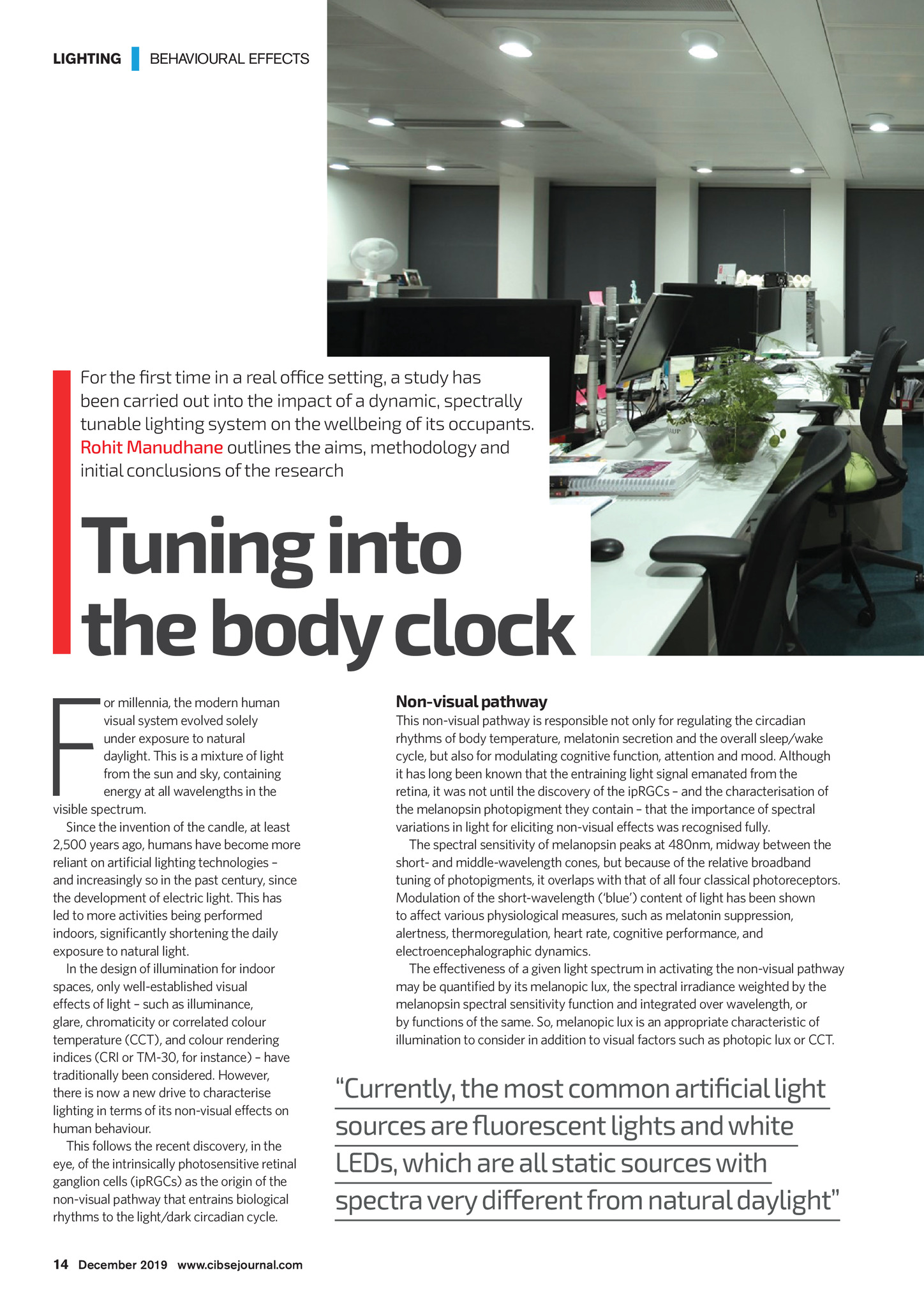
LIGHTING | BEHAVIOURAL EFFECTS For the first time in a real office setting, a study has been carried out into the impact of a dynamic, spectrally tunable lighting system on the wellbeing of its occupants. Rohit Manudhane outlines the aims, methodology and initial conclusions of the research Tuning into the body clock F or millennia, the modern human visual system evolved solely under exposure to natural daylight. This is a mixture of light from the sun and sky, containing energy at all wavelengths in the visible spectrum. Since the invention of the candle, at least 2,500 years ago, humans have become more reliant on artificial lighting technologies and increasingly so in the past century, since the development of electric light. This has led to more activities being performed indoors, significantly shortening the daily exposure to natural light. In the design of illumination for indoor spaces, only well-established visual effects of light such as illuminance, glare, chromaticity or correlated colour temperature (CCT), and colour rendering indices (CRI or TM-30, for instance) have traditionally been considered. However, there is now a new drive to characterise lighting in terms of its non-visual effects on human behaviour. This follows the recent discovery, in the eye, of the intrinsically photosensitive retinal ganglion cells (ipRGCs) as the origin of the non-visual pathway that entrains biological rhythms to the light/dark circadian cycle. Non-visual pathway This non-visual pathway is responsible not only for regulating the circadian rhythms of body temperature, melatonin secretion and the overall sleep/wake cycle, but also for modulating cognitive function, attention and mood. Although it has long been known that the entraining light signal emanated from the retina, it was not until the discovery of the ipRGCs and the characterisation of the melanopsin photopigment they contain that the importance of spectral variations in light for eliciting non-visual effects was recognised fully. The spectral sensitivity of melanopsin peaks at 480nm, midway between the short- and middle-wavelength cones, but because of the relative broadband tuning of photopigments, it overlaps with that of all four classical photoreceptors. Modulation of the short-wavelength (blue) content of light has been shown to affect various physiological measures, such as melatonin suppression, alertness, thermoregulation, heart rate, cognitive performance, and electroencephalographic dynamics. The effectiveness of a given light spectrum in activating the non-visual pathway may be quantified by its melanopic lux, the spectral irradiance weighted by the melanopsin spectral sensitivity function and integrated over wavelength, or by functions of the same. So, melanopic lux is an appropriate characteristic of illumination to consider in addition to visual factors such as photopic lux or CCT. Currently, the most common artificial light sources are fluorescent lights and white LEDs, which are all static sources with spectra very different from natural daylight 14 December 2019 www.cibsejournal.com CIBSE Dec19 pp14-17 ARUP Lighting Supp.indd 14 22/11/2019 14:56