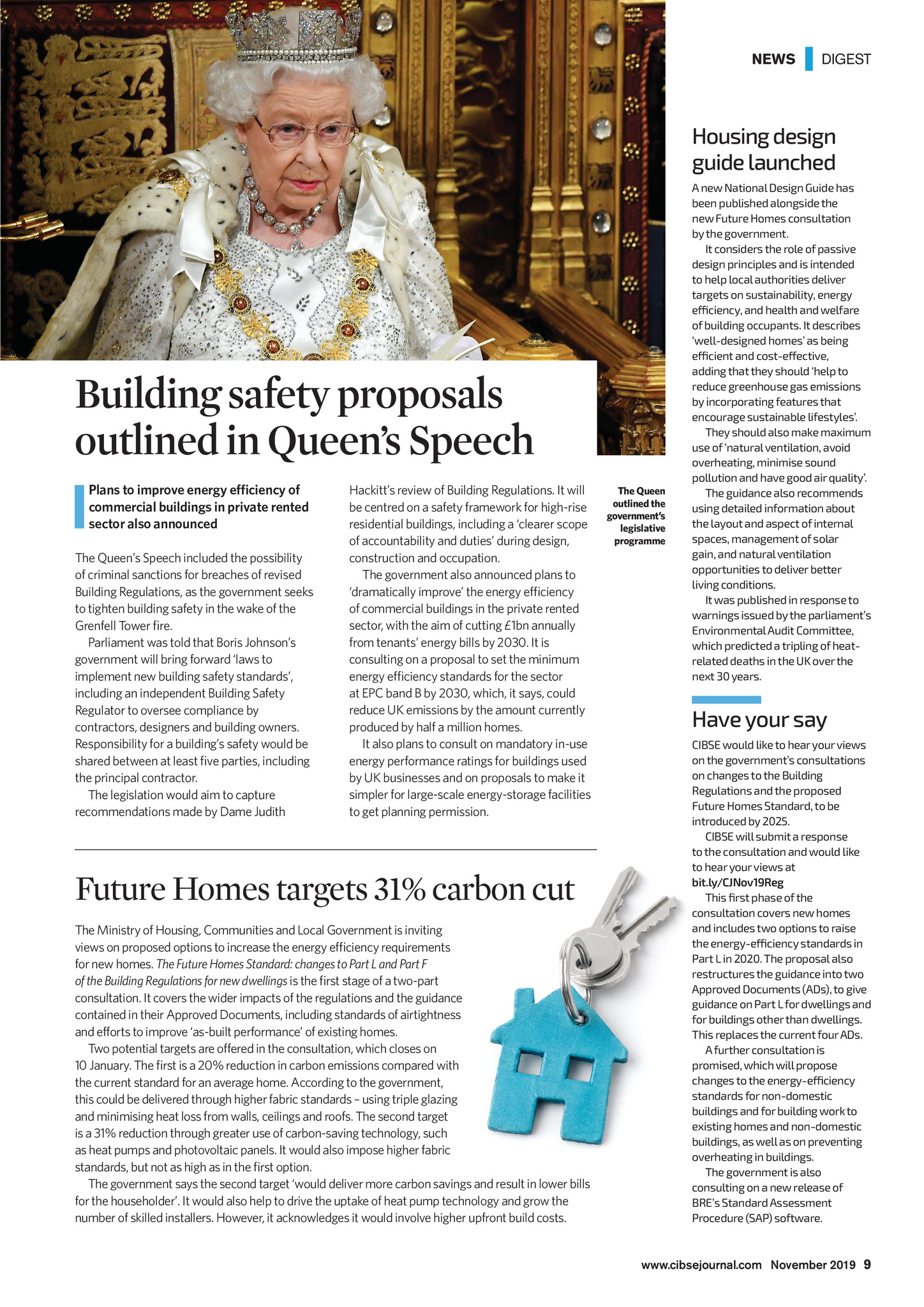
EWS | DIGEST Housing design guide launched Building safety proposals outlined in Queens Speech Plans to improve energy efficiency of commercial buildings in private rented sector also announced The Queens Speech included the possibility of criminal sanctions for breaches of revised Building Regulations, as the government seeks to tighten building safety in the wake of the Grenfell Tower fire. Parliament was told that Boris Johnsons government will bring forward laws to implement new building safety standards, including an independent Building Safety Regulator to oversee compliance by contractors, designers and building owners. Responsibility for a buildings safety would be shared between at least five parties, including the principal contractor. The legislation would aim to capture recommendations made by Dame Judith Hackitts review of Building Regulations. It will be centred on a safety framework for high-rise residential buildings, including a clearer scope of accountability and duties during design, construction and occupation. The government also announced plans to dramatically improve the energy efficiency of commercial buildings in the private rented sector, with the aim of cutting 1bn annually from tenants energy bills by 2030. It is consulting on a proposal to set the minimum energy efficiency standards for the sector at EPC band B by 2030, which, it says, could reduce UK emissions by the amount currently produced by half a million homes. It also plans to consult on mandatory in-use energy performance ratings for buildings used by UK businesses and on proposals to make it simpler for large-scale energy-storage facilities to get planning permission. Future Homes targets 31% carbon cut The Ministry of Housing, Communities and Local Government is inviting views on proposed options to increase the energy efficiency requirements for new homes. The Future Homes Standard: changes to Part L and Part F of the Building Regulations for new dwellings is the first stage of a two-part consultation. It covers the wider impacts of the regulations and the guidance contained in their Approved Documents, including standards of airtightness and efforts to improve as-built performance of existing homes. Two potential targets are offered in the consultation, which closes on 10 January. The first is a 20% reduction in carbon emissions compared with the current standard for an average home. According to the government, this could be delivered through higher fabric standards using triple glazing and minimising heat loss from walls, ceilings and roofs. The second target is a 31% reduction through greater use of carbon-saving technology, such as heat pumps and photovoltaic panels. It would also impose higher fabric standards, but not as high as in the first option. The government says the second target would deliver more carbon savings and result in lower bills for the householder. It would also help to drive the uptake of heat pump technology and grow the number of skilled installers. However, it acknowledges it would involve higher upfront build costs. The Queen outlined the governments legislative programme A new National Design Guide has been published alongside the new Future Homes consultation by the government. It considers the role of passive design principles and is intended to help local authorities deliver targets on sustainability, energy efficiency, and health and welfare of building occupants. It describes well-designed homes as being efficient and cost-effective, adding that they should help to reduce greenhouse gas emissions by incorporating features that encourage sustainable lifestyles. They should also make maximum use of natural ventilation, avoid overheating, minimise sound pollution and have good air quality. The guidance also recommends using detailed information about the layout and aspect of internal spaces, management of solar gain, and natural ventilation opportunities to deliver better living conditions. It was published in response to warnings issued by the parliaments Environmental Audit Committee, which predicted a tripling of heatrelated deaths in the UK over the next 30 years. Have your say CIBSE would like to hear your views on the governments consultations on changes to the Building Regulations and the proposed Future Homes Standard, to be introduced by 2025. CIBSE will submit a response to the consultation and would like to hear your views at bit.ly/CJNov19Reg This first phase of the consultation covers new homes and includes two options to raise the energy-efficiency standards in Part L in 2020. The proposal also restructures the guidance into two Approved Documents (ADs), to give guidance on Part L for dwellings and for buildings other than dwellings. This replaces the current four ADs. A further consultation is promised, which will propose changes to the energy-efficiency standards for non-domestic buildings and for building work to existing homes and non-domestic buildings, as well as on preventing overheating in buildings. The government is also consulting on a new release of BREs Standard Assessment Procedure (SAP) software. www.cibsejournal.com November 2019 9 CIBSE Nov19 pp08-09 News.indd 9 25/10/2019 15:22