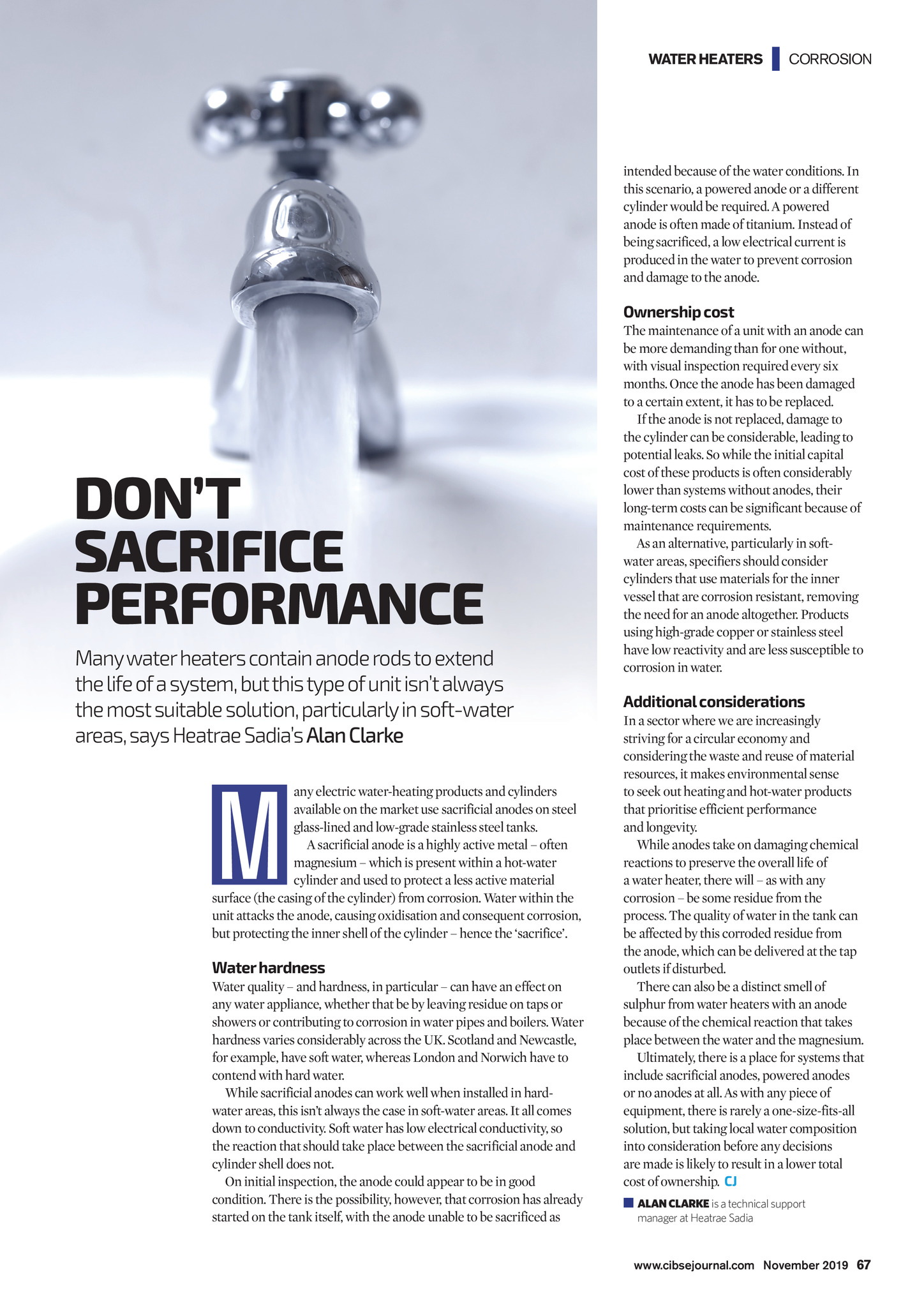
WATER HEATERS | CORROSION intended because of the water conditions. In this scenario, a powered anode or a different cylinder would be required. A powered anode is often made of titanium. Instead of being sacrificed, a low electrical current is produced in the water to prevent corrosion and damage to the anode. Ownership cost DONT SACRIFICE PERFORMANCE Many water heaters contain anode rods to extend the life of a system, but this type of unit isnt always the most suitable solution, particularly in soft-water areas, says Heatrae Sadias Alan Clarke M any electric water-heating products and cylinders available on the market use sacrificial anodes on steel glass-lined and low-grade stainless steel tanks. A sacrificial anode is a highly active metal often magnesium which is present within a hot-water cylinder and used to protect a less active material surface (the casing of the cylinder) from corrosion. Water within the unit attacks the anode, causing oxidisation and consequent corrosion, but protecting the inner shell of the cylinder hence the sacrifice. Water hardness Water quality and hardness, in particular can have an effect on any water appliance, whether that be by leaving residue on taps or showers or contributing to corrosion in water pipes and boilers. Water hardness varies considerably across the UK. Scotland and Newcastle, for example, have soft water, whereas London and Norwich have to contend with hard water. While sacrificial anodes can work well when installed in hardwater areas, this isnt always the case in soft-water areas. It all comes down to conductivity. Soft water has low electrical conductivity, so the reaction that should take place between the sacrificial anode and cylinder shell does not. On initial inspection, the anode could appear to be in good condition. There is the possibility, however, that corrosion has already started on the tank itself, with the anode unable to be sacrificed as The maintenance of a unit with an anode can be more demanding than for one without, with visual inspection required every six months. Once the anode has been damaged to a certain extent, it has to be replaced. If the anode is not replaced, damage to the cylinder can be considerable, leading to potential leaks. So while the initial capital cost of these products is often considerably lower than systems without anodes, their long-term costs can be significant because of maintenance requirements. As an alternative, particularly in softwater areas, specifiers should consider cylinders that use materials for the inner vessel that are corrosion resistant, removing the need for an anode altogether. Products using high-grade copper or stainless steel have low reactivity and are less susceptible to corrosion in water. Additional considerations In a sector where we are increasingly striving for a circular economy and considering the waste and reuse of material resources, it makes environmental sense to seek out heating and hot-water products that prioritise efficient performance and longevity. While anodes take on damaging chemical reactions to preserve the overall life of a water heater, there will as with any corrosion be some residue from the process. The quality of water in the tank can be affected by this corroded residue from the anode, which can be delivered at the tap outlets if disturbed. There can also be a distinct smell of sulphur from water heaters with an anode because of the chemical reaction that takes place between the water and the magnesium. Ultimately, there is a place for systems that include sacrificial anodes, powered anodes or no anodes at all. As with any piece of equipment, there is rarely a one-size-fits-all solution, but taking local water composition into consideration before any decisions are made is likely to result in a lower total cost of ownership. CJ ALAN CLARKE is a technical support manager at Heatrae Sadia www.cibsejournal.com November 2019 67 CIBSE Nov19 pp67 Anodes.indd 67 25/10/2019 15:32