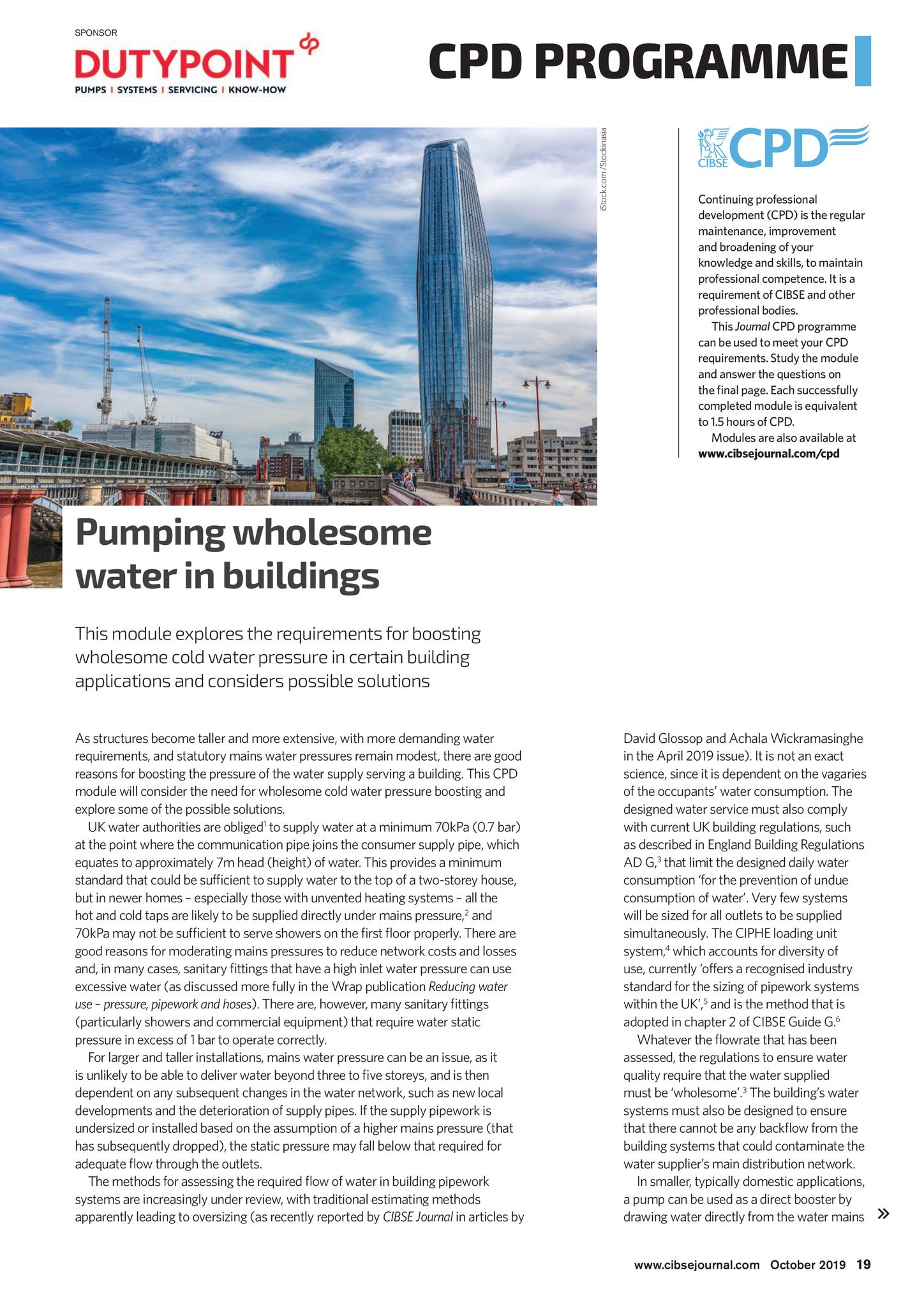
SPONSOR CPD PROGRAMME Continuing professional development (CPD) is the regular maintenance, improvement and broadening of your knowledge and skills, to maintain professional competence. It is a requirement of CIBSE and other professional bodies. This Journal CPD programme can be used to meet your CPD requirements. Study the module and answer the questions on the final page ach successfully completed module is equivalent to 1.5 hours of CPD. Modules are also available at www.cibsejournal.com/cpd Pumping wholesome water in buildings This module explores the requirements for boosting wholesome cold water pressure in certain building applications and considers possible solutions As structures become taller and more extensive, with more demanding water requirements, and statutory mains water pressures remain modest, there are good reasons for boosting the pressure of the water supply serving a building. This CPD module will consider the need for wholesome cold water pressure boosting and explore some of the possible solutions. UK water authorities are obliged1 to supply water at a minimum 70kPa (0.7 bar) at the point where the communication pipe joins the consumer supply pipe, which equates to approximately 7m head (height) of water. This provides a minimum standard that could be sufcient to supply water to the top of a two-storey house, but in newer homes especially those with unvented heating systems all the hot and cold taps are likely to be supplied directly under mains pressure,2 and 0kPa may not be sufcient to serve showers on the rst oor properly. There are good reasons for moderating mains pressures to reduce network costs and losses and, in many cases, sanitary ttings that have a high inlet water pressure can use excessive water (as discussed more fully in the Wrap publication Reducing water use pressure, pipework and hoses). There are, however, many sanitary ttings (particularly showers and commercial equipment) that require water static pressure in excess of 1 bar to operate correctly. For larger and taller installations, mains water pressure can be an issue, as it is unlikely to be able to deliver water beyond three to ve storeys, and is then dependent on any subsequent changes in the water network, such as new local developments and the deterioration of supply pipes. If the supply pipework is undersized or installed based on the assumption of a higher mains pressure (that has subsequently dropped), the static pressure may fall below that required for adequate ow through the outlets. The methods for assessing the required ow of water in building pipework systems are increasingly under review, with traditional estimating methods apparently leading to oversizing (as recently reported by CIBSE Journal in articles by David Glossop and Achala Wickramasinghe in the April 2019 issue). It is not an exact science, since it is dependent on the vagaries of the occupants water consumption. The designed water service must also comply with current UK building regulations, such as described in England Building Regulations AD G,3 that limit the designed daily water consumption for the prevention of undue consumption of water. Very few systems will be sized for all outlets to be supplied simultaneously. The CIPHE loading unit system,4 which accounts for diversity of use, currently offers a recognised industry standard for the sizing of pipework systems within the UK,5 and is the method that is adopted in chapter 2 of CIBSE Guide G.6 Whatever the owrate that has been assessed, the regulations to ensure water quality require that the water supplied must be wholesome.3 The buildings water systems must also be designed to ensure that there cannot be any backow from the building systems that could contaminate the water suppliers main distribution network. In smaller, typically domestic applications, a pump can be used as a direct booster by drawing water directly from the water mains www.cibsejournal.com October 2019 19 CIBSE Oct19 pp19-22 CPD 153 Supp v2.indd 19 20/09/2019 13:50