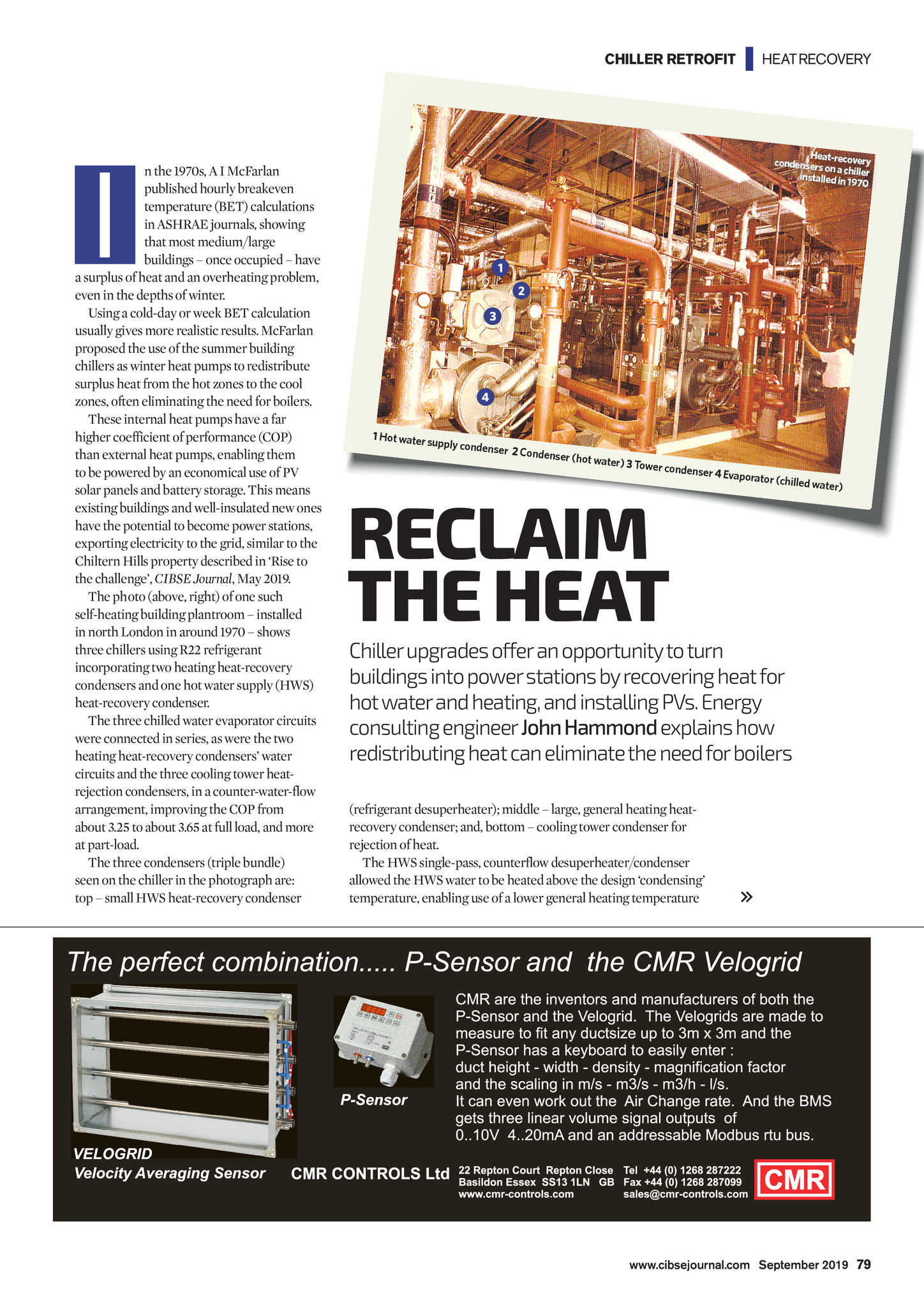

CHILLER RETROFIT Hea condensers t-recovery on a ch installed in iller 1970 I n the 1970s, A I McFarlan published hourly breakeven temperature (BET) calculations in ASHRAE journals, showing that most medium/large buildings once occupied have a surplus of heat and an overheating problem, even in the depths of winter. Using a cold-day or week BET calculation usually gives more realistic results. McFarlan proposed the use of the summer building chillers as winter heat pumps to redistribute surplus heat from the hot zones to the cool zones, often eliminating the need for boilers. These internal heat pumps have a far higher coefficient of performance (COP) than external heat pumps, enabling them to be powered by an economical use of PV solar panels and battery storage. This means existing buildings and well-insulated new ones have the potential to become power stations, exporting electricity to the grid, similar to the Chiltern Hills property described in Rise to the challenge, CIBSE Journal, May 2019. The photo (above, right) of one such self-heating building plantroom installed in north London in around 1970 shows three chillers using R22 refrigerant incorporating two heating heat-recovery condensers and one hot water supply (HWS) heat-recovery condenser. The three chilled water evaporator circuits were connected in series, as were the two heating heat-recovery condensers water circuits and the three cooling tower heatrejection condensers, in a counter-water-flow arrangement, improving the COP from about 3.25 to about 3.65 at full load, and more at part-load. The three condensers (triple bundle) seen on the chiller in the photograph are: top small HWS heat-recovery condenser | HEAT RECOVERY 1 Hot water supply cond enser 2 Cond enser (hot w ater) 3 Tower condenser 4 Evaporator (c hilled water ) RECLAIM THE HEAT Chiller upgrades offer an opportunity to turn buildings into power stations by recovering heat for hot water and heating, and installing PVs. Energy consulting engineer John Hammond explains how redistributing heat can eliminate the need for boilers (refrigerant desuperheater); middle large, general heating heatrecovery condenser; and, bottom cooling tower condenser for rejection of heat. The HWS single-pass, counterflow desuperheater/condenser allowed the HWS water to be heated above the design condensing temperature, enabling use of a lower general heating temperature www.cibsejournal.com September 2019 79 CIBSE Sep19 pp79-80 Heat recovery Hammond.indd 79 23/08/2019 15:27