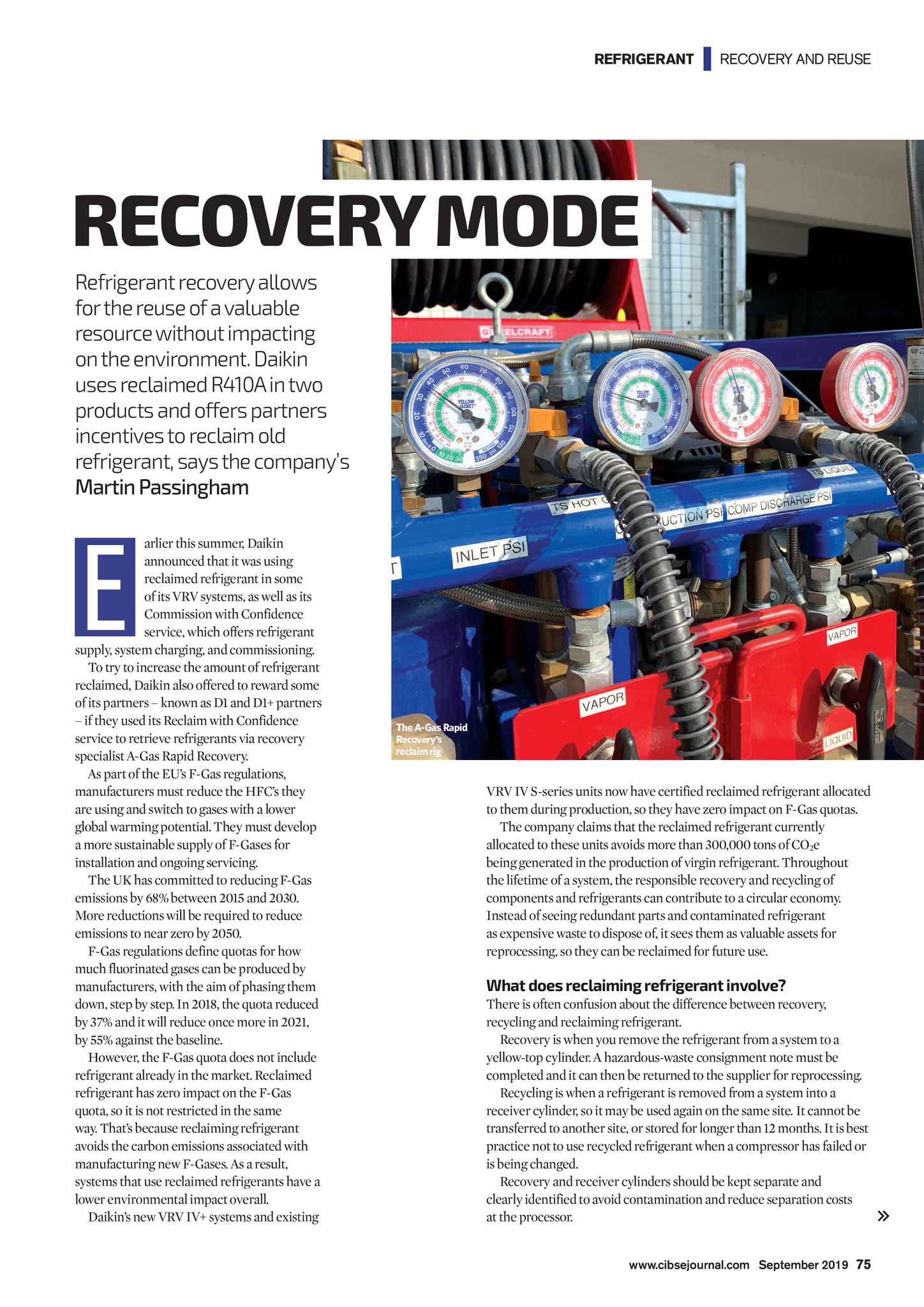
REFRIGERANT | RECOVERY AND REUSE RECOVERY MODE Refrigerant recovery allows for the reuse of a valuable resource without impacting on the environment. Daikin uses reclaimed R410A in two products and offers partners incentives to reclaim old refrigerant, says the companys Martin Passingham E arlier this summer, Daikin announced that it was using reclaimed refrigerant in some of its VRV systems, as well as its Commission with Confidence service, which offers refrigerant supply, system charging, and commissioning. To try to increase the amount of refrigerant reclaimed, Daikin also offered to reward some of its partners known as D1 and D1+ partners if they used its Reclaim with Confidence service to retrieve refrigerants via recovery specialist A-Gas Rapid Recovery. As part of the EUs F-Gas regulations, manufacturers must reduce the HFCs they are using and switch to gases with a lower global warming potential. They must develop a more sustainable supply of F-Gases for installation and ongoing servicing. The UK has committed to reducing F-Gas emissions by 68% between 2015 and 2030. More reductions will be required to reduce emissions to near zero by 2050. F-Gas regulations define quotas for how much fluorinated gases can be produced by manufacturers, with the aim of phasing them down, step by step. In 2018, the quota reduced by 37% and it will reduce once more in 2021, by 55% against the baseline. However, the F-Gas quota does not include refrigerant already in the market. Reclaimed refrigerant has zero impact on the F-Gas quota, so it is not restricted in the same way. Thats because reclaiming refrigerant avoids the carbon emissions associated with manufacturing new F-Gases. As a result, systems that use reclaimed refrigerants have a lower environmental impact overall. Daikins new VRV IV+ systems and existing The A-Gas Rapid Recoverys reclaim rig VRV IV S-series units now have certified reclaimed refrigerant allocated to them during production, so they have zero impact on F-Gas quotas. The company claims that the reclaimed refrigerant currently allocated to these units avoids more than 300,000 tons of CO2e being generated in the production of virgin refrigerant. Throughout the lifetime of a system, the responsible recovery and recycling of components and refrigerants can contribute to a circular economy. Instead of seeing redundant parts and contaminated refrigerant as expensive waste to dispose of, it sees them as valuable assets for reprocessing, so they can be reclaimed for future use. What does reclaiming refrigerant involve? There is often confusion about the difference between recovery, recycling and reclaiming refrigerant. Recovery is when you remove the refrigerant from a system to a yellow-top cylinder. A hazardous-waste consignment note must be completed and it can then be returned to the supplier for reprocessing. Recycling is when a refrigerant is removed from a system into a receiver cylinder, so it may be used again on the same site. It cannot be transferred to another site, or stored for longer than 12 months. It is best practice not to use recycled refrigerant when a compressor has failed or is being changed. Recovery and receiver cylinders should be kept separate and clearly identified to avoid contamination and reduce separation costs at the processor. www.cibsejournal.com September 2019 75 CIBSE Sep19 pp75-76 Daikin reclaim.indd 75 23/08/2019 15:20