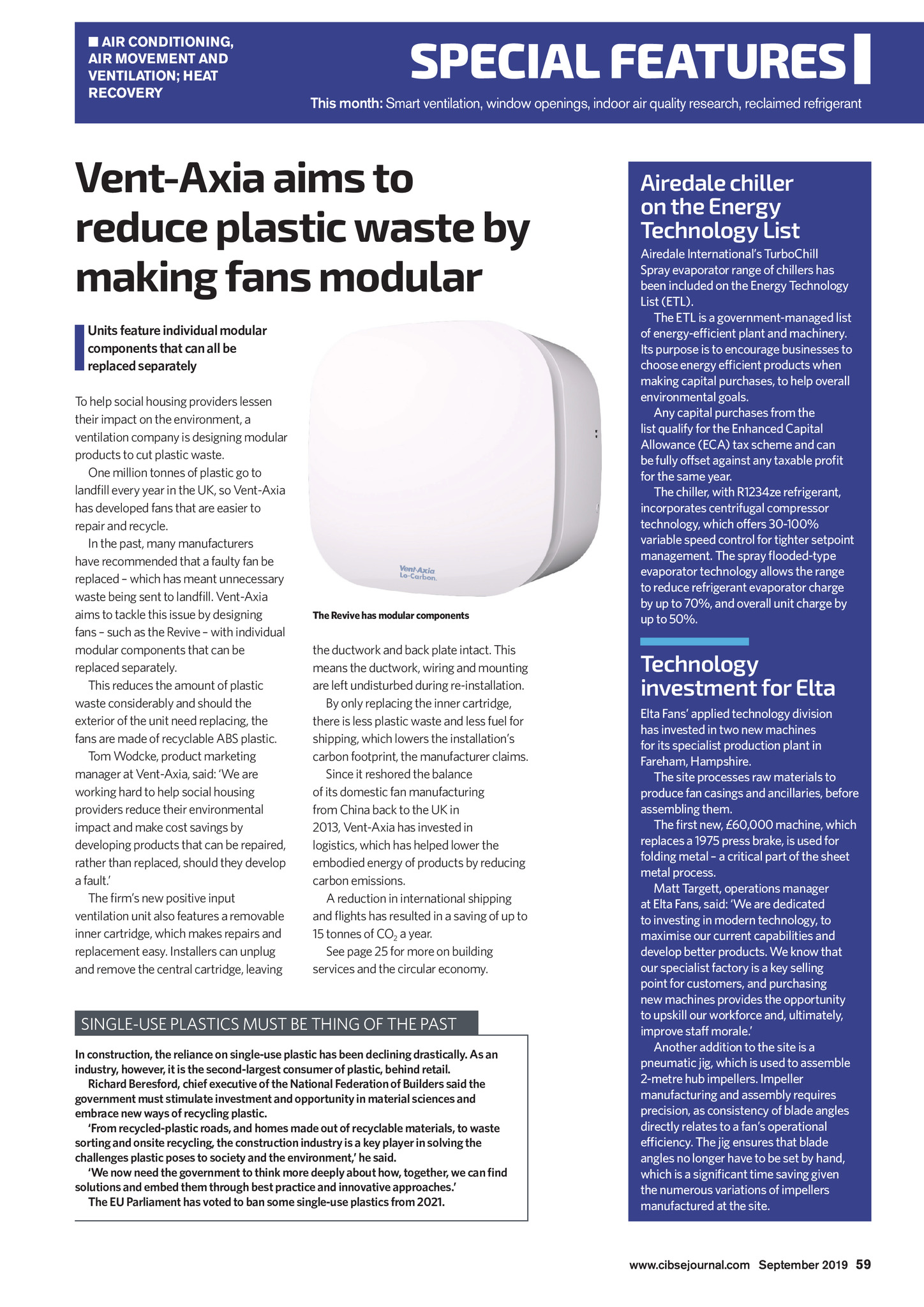

AIR CONDITIONING, AIR MOVEMENT AND VENTILATION; HEAT RECOVERY SPECIAL FEATURES This month: Smart ventilation, window openings, indoor air quality research, reclaimed refrigerant Vent-Axia aims to reduce plastic waste by making fans modular Units feature individual modular components that can all be replaced separately To help social housing providers lessen their impact on the environment, a ventilation company is designing modular products to cut plastic waste. One million tonnes of plastic go to landfill every year in the UK, so Vent-Axia has developed fans that are easier to repair and recycle. In the past, many manufacturers have recommended that a faulty fan be replaced which has meant unnecessary waste being sent to landfill. Vent-Axia aims to tackle this issue by designing fans such as the Revive with individual modular components that can be replaced separately. This reduces the amount of plastic waste considerably and should the exterior of the unit need replacing, the fans are made of recyclable ABS plastic. Tom Wodcke, product marketing manager at Vent-Axia, said: We are working hard to help social housing providers reduce their environmental impact and make cost savings by developing products that can be repaired, rather than replaced, should they develop a fault. The firms new positive input ventilation unit also features a removable inner cartridge, which makes repairs and replacement easy. Installers can unplug and remove the central cartridge, leaving The Revive has modular components the ductwork and back plate intact. This means the ductwork, wiring and mounting are left undisturbed during re-installation. By only replacing the inner cartridge, there is less plastic waste and less fuel for shipping, which lowers the installations carbon footprint, the manufacturer claims. Since it reshored the balance of its domestic fan manufacturing from China back to the UK in 2013, Vent-Axia has invested in logistics, which has helped lower the embodied energy of products by reducing carbon emissions. A reduction in international shipping and flights has resulted in a saving of up to 15 tonnes of CO2 a year. See page 25 for more on building services and the circular economy. SINGLE-USE PLASTICS MUST BE THING OF THE PAST In construction, the reliance on single-use plastic has been declining drastically. As an industry, however, it is the second-largest consumer of plastic, behind retail. Richard Beresford, chief executive of the National Federation of Builders said the government must stimulate investment and opportunity in material sciences and embrace new ways of recycling plastic. From recycled-plastic roads, and homes made out of recyclable materials, to waste sorting and onsite recycling, the construction industry is a key player in solving the challenges plastic poses to society and the environment, he said. We now need the government to think more deeply about how, together, we can find solutions and embed them through best practice and innovative approaches. The EU Parliament has voted to ban some single-use plastics from 2021. Airedale chiller on the Energy Technology List Airedale Internationals TurboChill Spray evaporator range of chillers has been included on the Energy Technology List (ETL). The ETL is a government-managed list of energy-efficient plant and machinery. Its purpose is to encourage businesses to choose energy efficient products when making capital purchases, to help overall environmental goals. Any capital purchases from the list qualify for the Enhanced Capital Allowance (ECA) tax scheme and can be fully offset against any taxable profit for the same year. The chiller, with R1234ze refrigerant, incorporates centrifugal compressor technology, which offers 30-100% variable speed control for tighter setpoint management. The spray flooded-type evaporator technology allows the range to reduce refrigerant evaporator charge by up to 70%, and overall unit charge by up to 50%. Technology investment for Elta Elta Fans applied technology division has invested in two new machines for its specialist production plant in Fareham, Hampshire. The site processes raw materials to produce fan casings and ancillaries, before assembling them. The first new, 60,000 machine, which replaces a 1975 press brake, is used for folding metal a critical part of the sheet metal process. Matt Targett, operations manager at Elta Fans, said: We are dedicated to investing in modern technology, to maximise our current capabilities and develop better products. We know that our specialist factory is a key selling point for customers, and purchasing new machines provides the opportunity to upskill our workforce and, ultimately, improve staff morale. Another addition to the site is a pneumatic jig, which is used to assemble 2-metre hub impellers. Impeller manufacturing and assembly requires precision, as consistency of blade angles directly relates to a fans operational efficiency. The jig ensures that blade angles no longer have to be set by hand, which is a significant time saving given the numerous variations of impellers manufactured at the site. www.cibsejournal.com September 2019 59 CIBSE Sep19 pp59-61 Aircon News.indd 59 23/08/2019 18:15