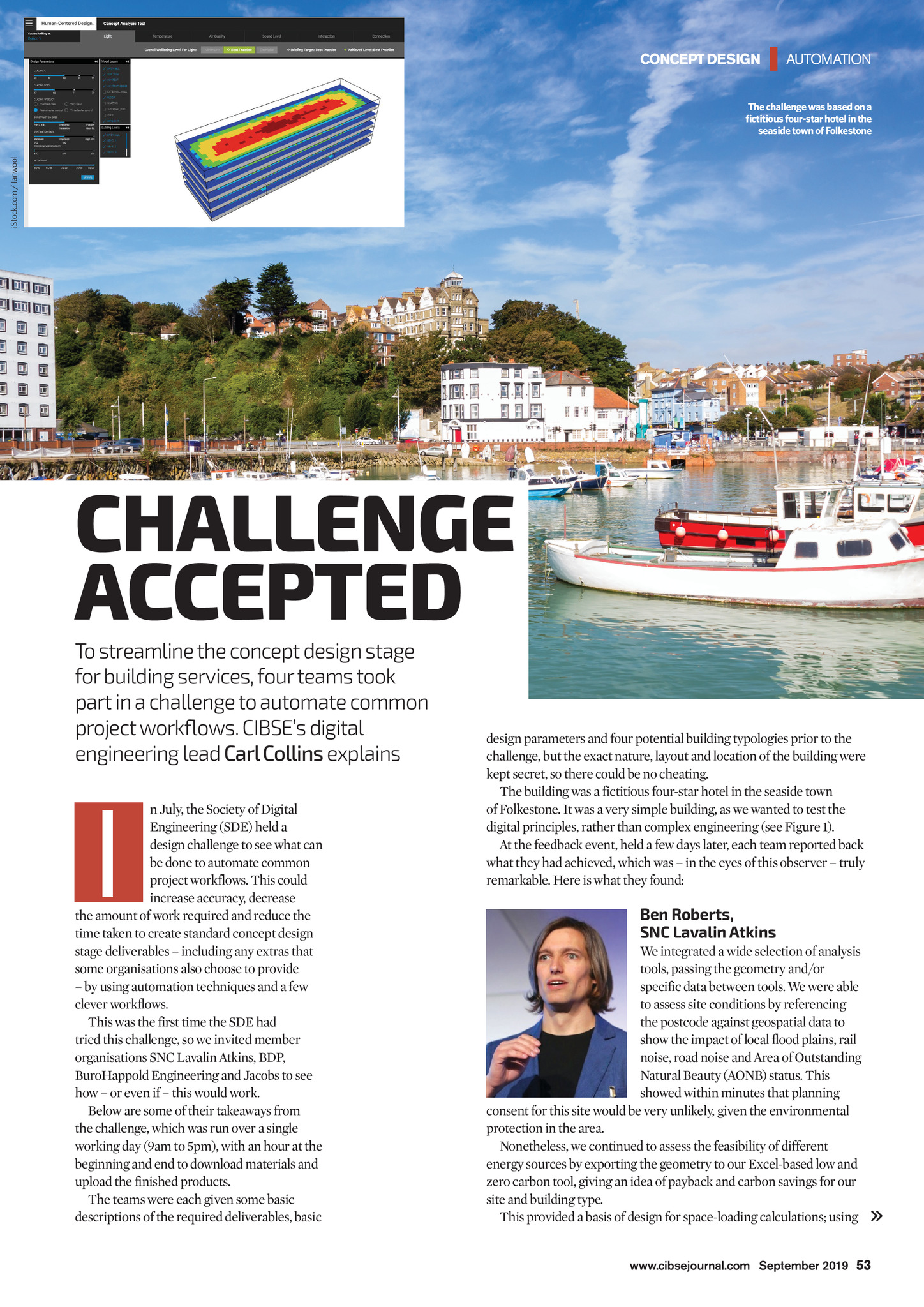
CONCEPT DESIGN | AUTOMATION iStock.com / Ianwool The challenge was based on a fictitious four-star hotel in the seaside town of Folkestone CHALLENGE ACCEPTED To streamline the concept design stage for building services, four teams took part in a challenge to automate common project workflows. CIBSEs digital engineering lead Carl Collins explains I n July, the Society of Digital Engineering (SDE) held a design challenge to see what can be done to automate common project workflows. This could increase accuracy, decrease the amount of work required and reduce the time taken to create standard concept design stage deliverables including any extras that some organisations also choose to provide by using automation techniques and a few clever workflows. This was the first time the SDE had tried this challenge, so we invited member organisations SNC Lavalin Atkins, BDP, BuroHappold Engineering and Jacobs to see how or even if this would work. Below are some of their takeaways from the challenge, which was run over a single working day (9am to 5pm), with an hour at the beginning and end to download materials and upload the finished products. The teams were each given some basic descriptions of the required deliverables, basic design parameters and four potential building typologies prior to the challenge, but the exact nature, layout and location of the building were kept secret, so there could be no cheating. The building was a fictitious four-star hotel in the seaside town of Folkestone. It was a very simple building, as we wanted to test the digital principles, rather than complex engineering (see Figure 1). At the feedback event, held a few days later, each team reported back what they had achieved, which was in the eyes of this observer truly remarkable. Here is what they found: Ben Roberts, SNC Lavalin Atkins We integrated a wide selection of analysis tools, passing the geometry and/or specific data between tools. We were able to assess site conditions by referencing the postcode against geospatial data to show the impact of local flood plains, rail noise, road noise and Area of Outstanding Natural Beauty (AONB) status. This showed within minutes that planning consent for this site would be very unlikely, given the environmental protection in the area. Nonetheless, we continued to assess the feasibility of different energy sources by exporting the geometry to our Excel-based low and zero carbon tool, giving an idea of payback and carbon savings for our site and building type. This provided a basis of design for space-loading calculations; using www.cibsejournal.com September 2019 53 CIBSE Sep19 pp53-54, 56 Concept design.indd 53 23/08/2019 18:13