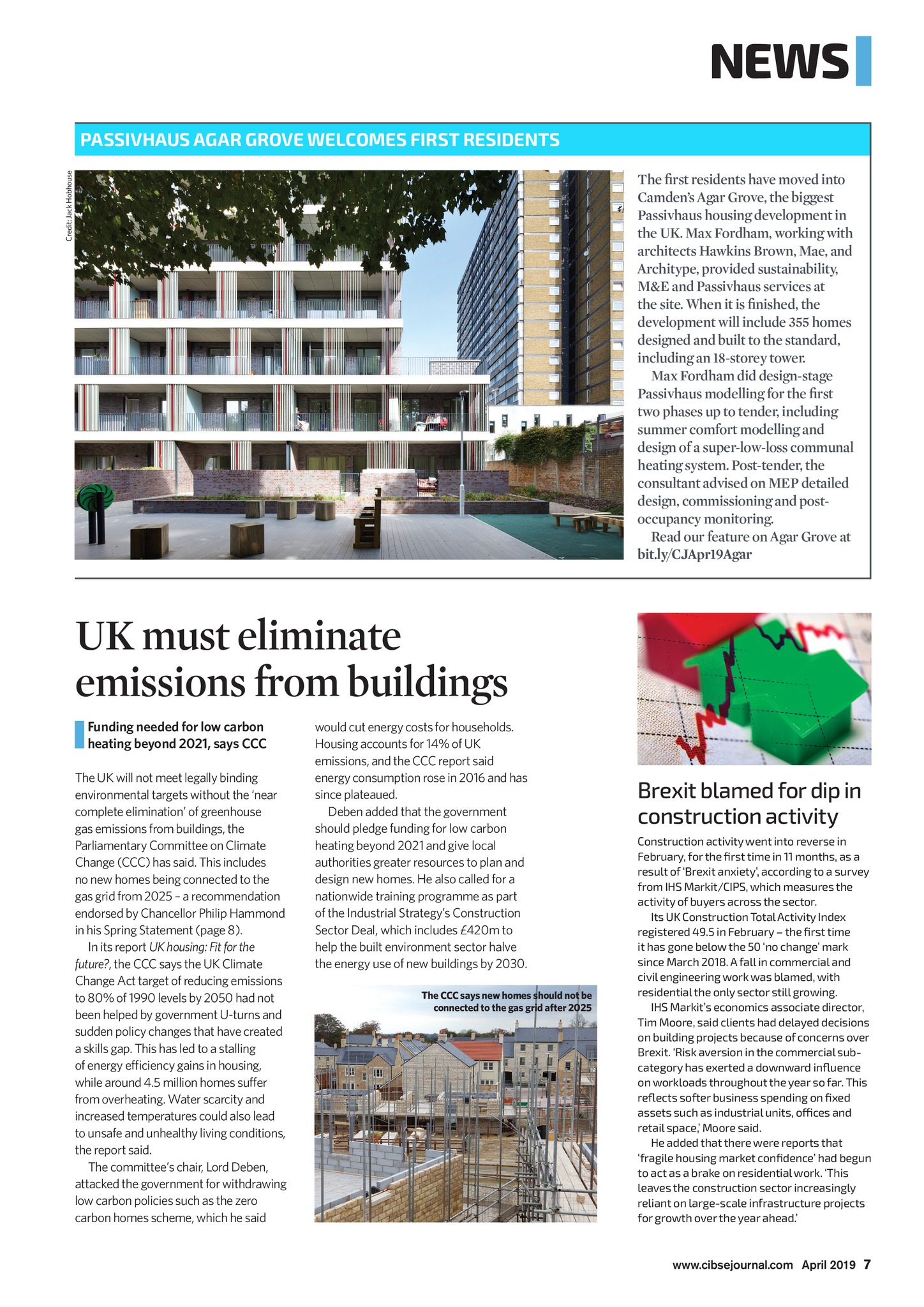

EWS Credit: Jack Hobhouse PASSIVHAUS AGAR GROVE WELCOMES FIRST RESIDENTS The first residents have moved into Camdens Agar Grove, the biggest Passivhaus housing development in the UK. Max Fordham, working with architects Hawkins Brown, Mae, and Architype, provided sustainability, M&E and Passivhaus services at the site. When it is finished, the development will include 355 homes designed and built to the standard, including an 18-storey tower. Max Fordham did design-stage Passivhaus modelling for the first two phases up to tender, including summer comfort modelling and design of a super-low-loss communal heating system. Post-tender, the consultant advised on MEP detailed design, commissioning and postoccupancy monitoring. Read our feature on Agar Grove at bit.ly/CJApr19Agar UK must eliminate emissions from buildings Funding needed for low carbon heating beyond 2021, says CCC The UK will not meet legally binding environmental targets without the near complete elimination of greenhouse gas emissions from buildings, the Parliamentary Committee on Climate Change (CCC) has said. This includes no new homes being connected to the gas grid from 2025 a recommendation endorsed by Chancellor Philip Hammond in his Spring Statement (page 8). In its report UK housing: Fit for the future?, the CCC says the UK Climate Change Act target of reducing emissions to 80% of 1990 levels by 2050 had not been helped by government U-turns and sudden policy changes that have created a skills gap. This has led to a stalling of energy efficiency gains in housing, while around 4.5 million homes suffer from overheating. Water scarcity and increased temperatures could also lead to unsafe and unhealthy living conditions, the report said. The committees chair, Lord Deben, attacked the government for withdrawing low carbon policies such as the zero carbon homes scheme, which he said would cut energy costs for households. Housing accounts for 14% of UK emissions, and the CCC report said energy consumption rose in 2016 and has since plateaued. Deben added that the government should pledge funding for low carbon heating beyond 2021 and give local authorities greater resources to plan and design new homes. He also called for a nationwide training programme as part of the Industrial Strategys Construction Sector Deal, which includes 420m to help the built environment sector halve the energy use of new buildings by 2030. The CCC says new homes should not be connected to the gas grid after 2025 Brexit blamed for dip in construction activity Construction activity went into reverse in February, for the first time in 11 months, as a result of Brexit anxiety, according to a survey from IHS Markit/CIPS, which measures the activity of buyers across the sector. Its UK Construction Total Activity Index registered 49.5 in February the first time it has gone below the 50 no change mark since March 2018. A fall in commercial and civil engineering work was blamed, with residential the only sector still growing. IHS Markits economics associate director, Tim Moore, said clients had delayed decisions on building projects because of concerns over Brexit. Risk aversion in the commercial subcategory has exerted a downward influence on workloads throughout the year so far. This reflects softer business spending on fixed assets such as industrial units, offices and retail space, Moore said. He added that there were reports that fragile housing market confidence had begun to act as a brake on residential work. This leaves the construction sector increasingly reliant on large-scale infrastructure projects for growth over the year ahead. www.cibsejournal.com April 2019 7 CIBSE Apr19 pp07 News.indd 7 22/03/2019 16:42