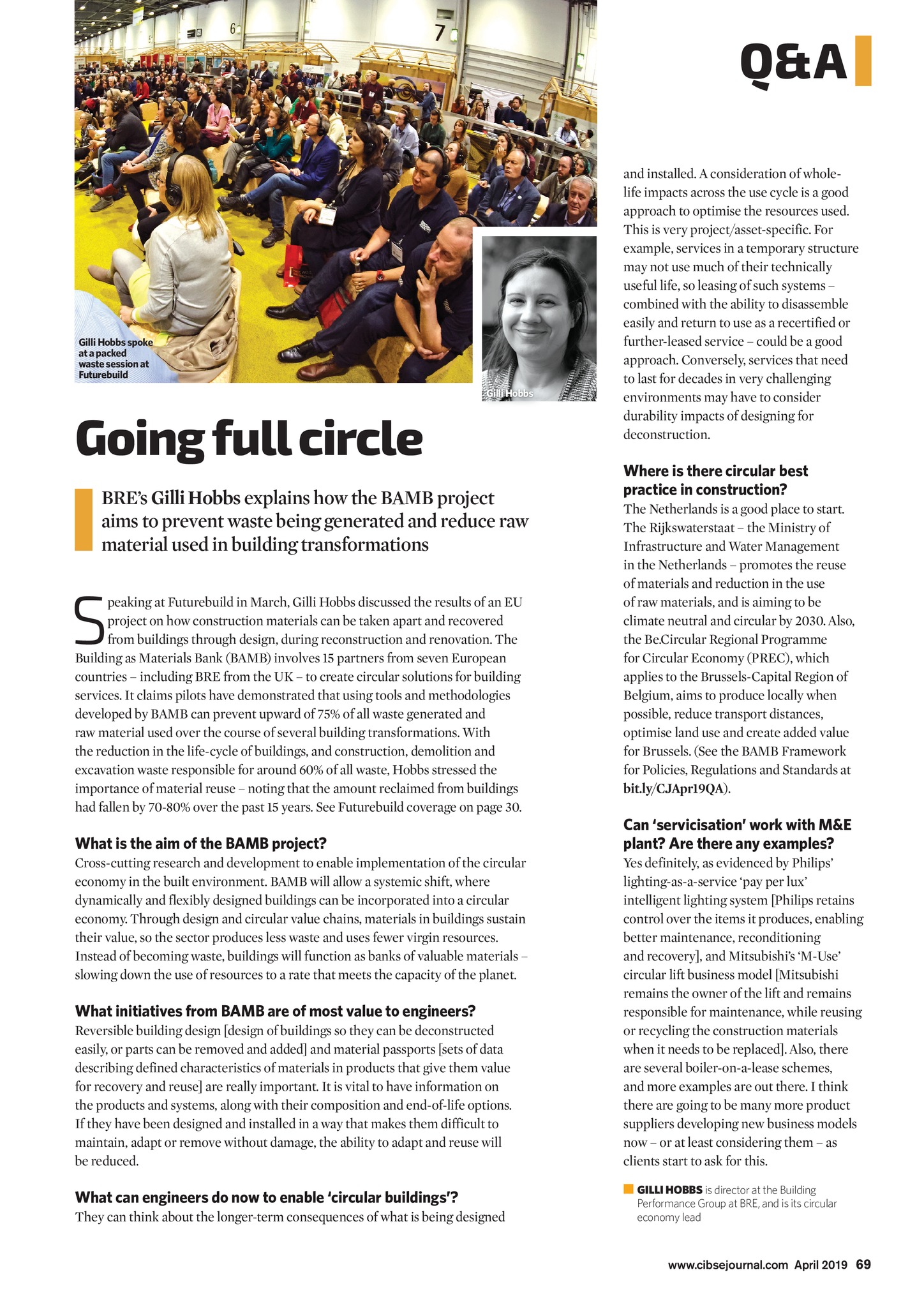
Q&A Gilli Hobbs spoke at a packed waste session at Futurebuild Gilli Hobbs Going full circle BREs Gilli Hobbs explains how the BAMB project aims to prevent waste being generated and reduce raw material used in building transformations S peaking at Futurebuild in March, Gilli Hobbs discussed the results of an EU project on how construction materials can be taken apart and recovered from buildings through design, during reconstruction and renovation. The Building as Materials Bank (BAMB) involves 15 partners from seven European countries including BRE from the UK to create circular solutions for building services. It claims pilots have demonstrated that using tools and methodologies developed by BAMB can prevent upward of 75% of all waste generated and raw material used over the course of several building transformations. With the reduction in the life-cycle of buildings, and construction, demolition and excavation waste responsible for around 60% of all waste, Hobbs stressed the importance of material reuse noting that the amount reclaimed from buildings had fallen by 70-80% over the past 15 years. See Futurebuild coverage on page 30. What is the aim of the BAMB project? Cross-cutting research and development to enable implementation of the circular economy in the built environment. BAMB will allow a systemic shift, where dynamically and flexibly designed buildings can be incorporated into a circular economy. Through design and circular value chains, materials in buildings sustain their value, so the sector produces less waste and uses fewer virgin resources. Instead of becoming waste, buildings will function as banks of valuable materials slowing down the use of resources to a rate that meets the capacity of the planet. What initiatives from BAMB are of most value to engineers? Reversible building design [design of buildings so they can be deconstructed easily, or parts can be removed and added] and material passports [sets of data describing defined characteristics of materials in products that give them value for recovery and reuse] are really important. It is vital to have information on the products and systems, along with their composition and end-of-life options. If they have been designed and installed in a way that makes them difficult to maintain, adapt or remove without damage, the ability to adapt and reuse will be reduced. What can engineers do now to enable circular buildings? They can think about the longer-term consequences of what is being designed and installed. A consideration of wholelife impacts across the use cycle is a good approach to optimise the resources used. This is very project/asset-specific. For example, services in a temporary structure may not use much of their technically useful life, so leasing of such systems combined with the ability to disassemble easily and return to use as a recertified or further-leased service could be a good approach. Conversely, services that need to last for decades in very challenging environments may have to consider durability impacts of designing for deconstruction. Where is there circular best practice in construction? The Netherlands is a good place to start. The Rijkswaterstaat the Ministry of Infrastructure and Water Management in the Netherlands promotes the reuse of materials and reduction in the use of raw materials, and is aiming to be climate neutral and circular by 2030. Also, the Be.Circular Regional Programme for Circular Economy (PREC), which applies to the Brussels-Capital Region of Belgium, aims to produce locally when possible, reduce transport distances, optimise land use and create added value for Brussels. (See the BAMB Framework for Policies, Regulations and Standards at bit.ly/CJApr19QA). Can servicisation work with M&E plant? Are there any examples? Yes definitely, as evidenced by Philips lighting-as-a-service pay per lux intelligent lighting system [Philips retains control over the items it produces, enabling better maintenance, reconditioning and recovery], and Mitsubishis M-Use circular lift business model [Mitsubishi remains the owner of the lift and remains responsible for maintenance, while reusing or recycling the construction materials when it needs to be replaced]. Also, there are several boiler-on-a-lease schemes, and more examples are out there. I think there are going to be many more product suppliers developing new business models now or at least considering them as clients start to ask for this. GILLI HOBBS is director at the Building Performance Group at BRE, and is its circular economy lead www.cibsejournal.com April 2019 69 CIBSE Apr19 pp69 Q&A v2.indd 69 22/03/2019 17:07