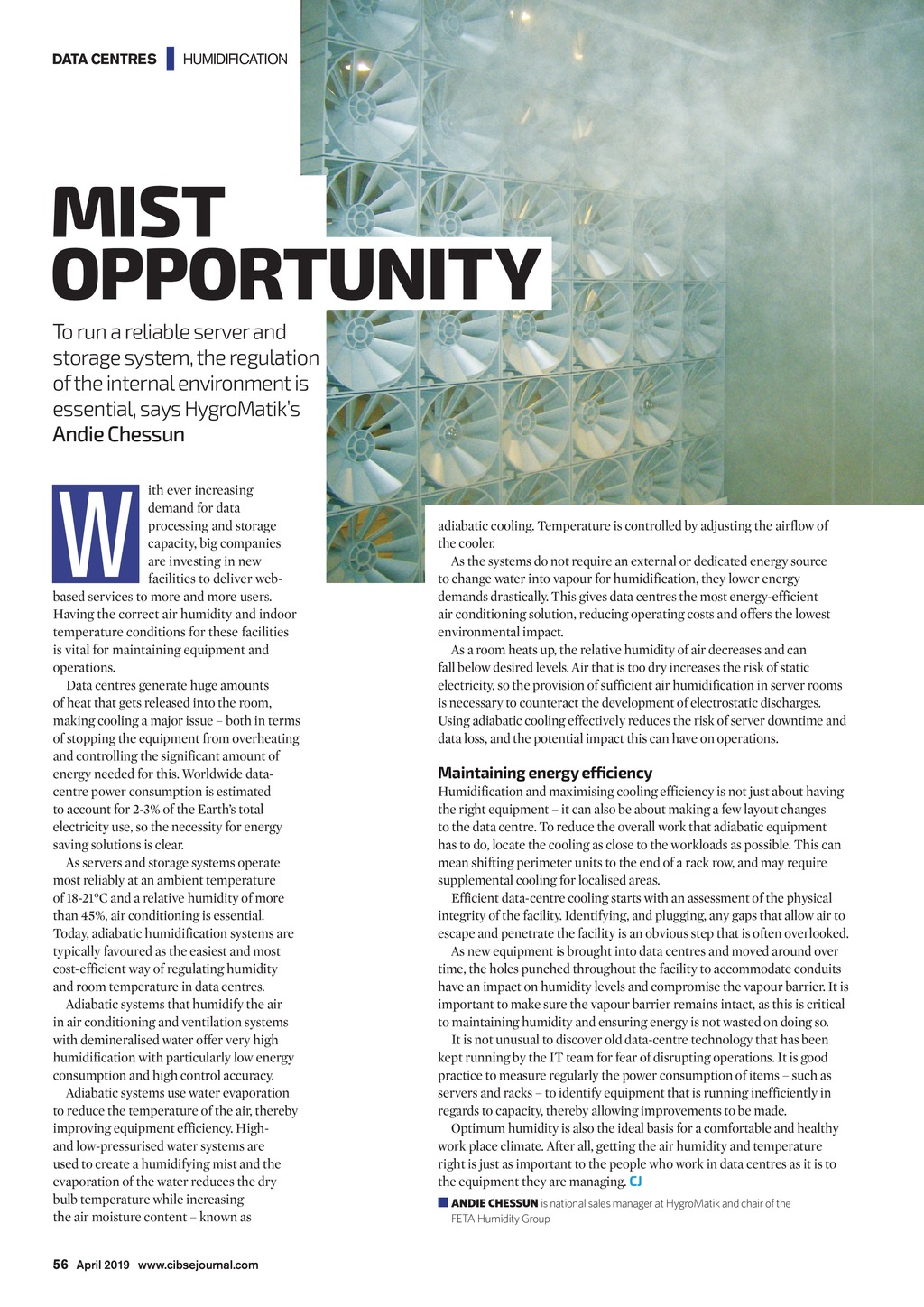

DATA CENTRES | HUMIDIFICATION MIST OPPORTUNITY To run a reliable server and storage system, the regulation of the internal environment is essential, says HygroMatiks Andie Chessun W ith ever increasing demand for data processing and storage capacity, big companies are investing in new facilities to deliver webbased services to more and more users. Having the correct air humidity and indoor temperature conditions for these facilities is vital for maintaining equipment and operations. Data centres generate huge amounts of heat that gets released into the room, making cooling a major issue both in terms of stopping the equipment from overheating and controlling the significant amount of energy needed for this. Worldwide datacentre power consumption is estimated to account for 2-3% of the Earths total electricity use, so the necessity for energy saving solutions is clear. As servers and storage systems operate most reliably at an ambient temperature of 18-21C and a relative humidity of more than 45%, air conditioning is essential. Today, adiabatic humidification systems are typically favoured as the easiest and most cost-efficient way of regulating humidity and room temperature in data centres. Adiabatic systems that humidify the air in air conditioning and ventilation systems with demineralised water offer very high humidification with particularly low energy consumption and high control accuracy. Adiabatic systems use water evaporation to reduce the temperature of the air, thereby improving equipment efficiency. Highand low-pressurised water systems are used to create a humidifying mist and the evaporation of the water reduces the dry bulb temperature while increasing the air moisture content known as adiabatic cooling. Temperature is controlled by adjusting the airflow of the cooler. As the systems do not require an external or dedicated energy source to change water into vapour for humidification, they lower energy demands drastically. This gives data centres the most energy-efficient air conditioning solution, reducing operating costs and offers the lowest environmental impact. As a room heats up, the relative humidity of air decreases and can fall below desired levels. Air that is too dry increases the risk of static electricity, so the provision of sufficient air humidification in server rooms isnecessary to counteract the development of electrostatic discharges. Using adiabatic cooling effectively reduces the risk ofserver downtime and data loss, and the potential impact this can have on operations. Maintaining energy efficiency Humidification and maximising cooling efficiency is not just about having the right equipment it can also be about making a few layout changes to the data centre. To reduce the overall work that adiabatic equipment has to do, locate the cooling as close to the workloads as possible. This can mean shifting perimeter units to the end of a rack row, and may require supplemental cooling for localised areas. Efficient data-centre cooling starts with an assessment of the physical integrity of the facility. Identifying, and plugging, any gaps that allow air to escape and penetrate the facility is an obvious step that is often overlooked. As new equipment is brought into data centres and moved around over time, the holes punched throughout the facility to accommodate conduits have an impact on humidity levels and compromise the vapour barrier. It is important to make sure the vapour barrier remains intact, as this is critical to maintaining humidity and ensuring energy is not wasted on doing so. It is not unusual to discover old data-centre technology that has been kept running by the IT team for fear of disrupting operations. It is good practice to measure regularly the power consumption of items such as servers and racks to identify equipment that is running inefficiently in regards to capacity, thereby allowing improvements to be made. Optimum humidity is also the ideal basis for a comfortable and healthy work place climate. After all, getting the air humidity and temperature right is just as important to the people whowork in data centres as it is to the equipment they are managing. CJ ANDIE CHESSUN is national sales manager at HygroMatik and chair of the FETA Humidity Group 56 April 2019 www.cibsejournal.com CIBSE Apr19 pp56 Hdromatik humidity.indd 56 22/03/2019 17:04