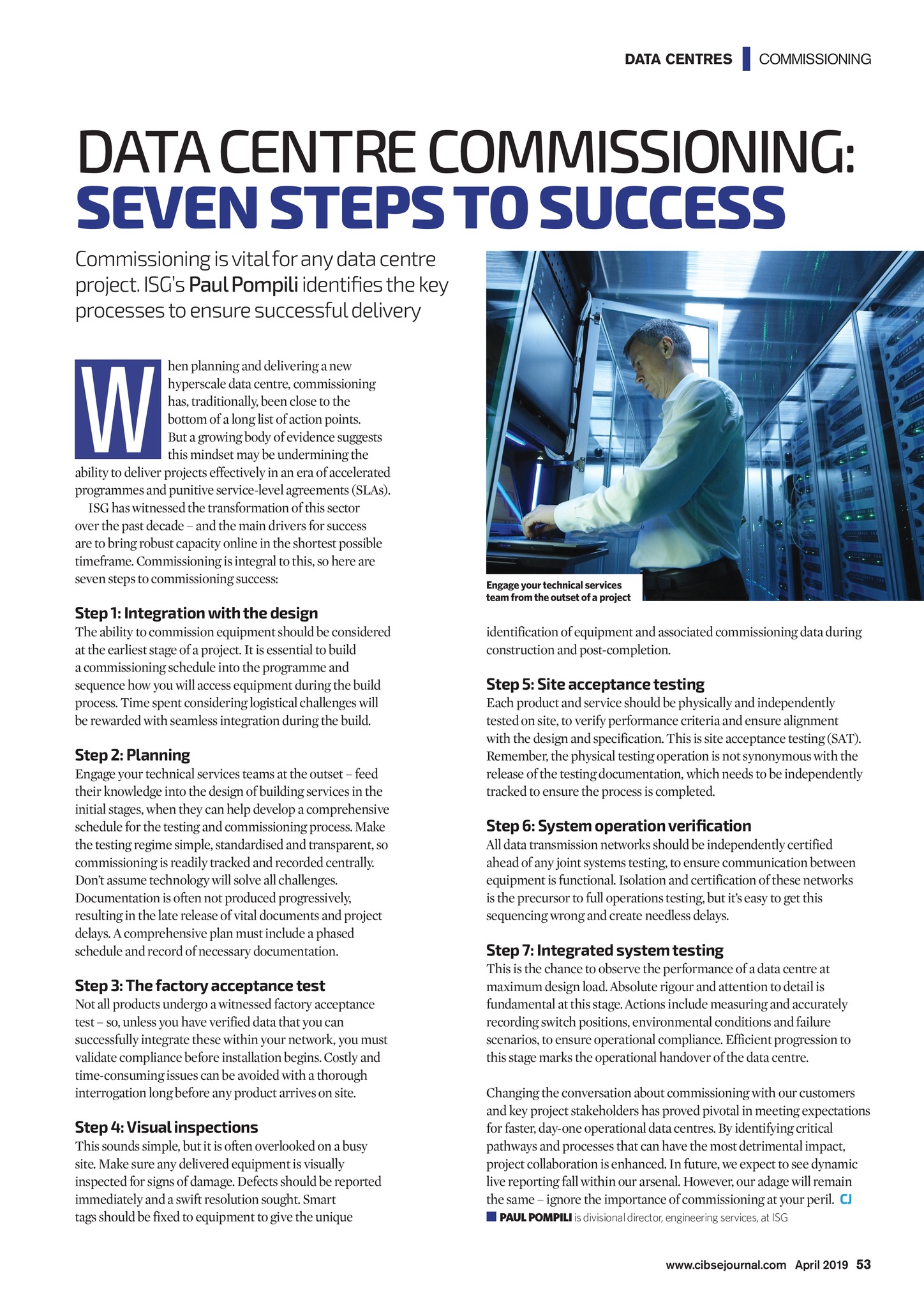
DATA CENTRES | COMMISSIONING DATA CENTRE COMMISSIONING: SEVEN STEPS TO SUCCESS Commissioning is vital for any data centre project. ISGs Paul Pompili identifies the key processes to ensure successful delivery W hen planning and delivering a new hyperscale data centre, commissioning has, traditionally, been close to the bottom of a long list of action points. But a growing body of evidence suggests this mindset may be undermining the ability to deliver projects effectively in an era of accelerated programmes and punitive service-level agreements (SLAs). ISG has witnessed the transformation of this sector over the past decade and the main drivers for success are to bring robust capacity online in the shortest possible timeframe. Commissioning is integral to this, so here are seven steps to commissioning success: Step 1: Integration with the design The ability to commission equipment should be considered at the earliest stage of a project. It is essential to build a commissioning schedule into the programme and sequence how you will access equipment during the build process. Time spent considering logistical challenges will be rewarded with seamless integration during the build. Step 2: Planning Engage your technical services teams at the outset feed their knowledge into the design of building services in the initial stages, when they can help develop a comprehensive schedule for the testing and commissioning process. Make the testing regime simple, standardised and transparent, so commissioning is readily tracked and recorded centrally. Dont assume technology will solve all challenges. Documentation is often not produced progressively, resulting in the late release of vital documents and project delays. A comprehensive plan must include a phased schedule and record of necessary documentation. Step 3: The factory acceptance test Not all products undergo a witnessed factory acceptance test so, unless you have verified data that you can successfully integrate these within your network, you must validate compliance before installation begins. Costly and time-consuming issues can be avoided with a thorough interrogation long before any product arrives on site. Step 4: Visual inspections This sounds simple, but it is often overlooked on a busy site. Make sure any delivered equipment is visually inspected for signs of damage. Defects should be reported immediately and a swift resolution sought. Smart tags should be fixed to equipment to give the unique Engage your technical services team from the outset of a project identification of equipment and associated commissioning data during construction and post-completion. Step 5: Site acceptance testing Each product and service should be physically and independently tested on site, to verify performance criteria and ensure alignment with the design and specification. This is site acceptance testing (SAT). Remember, the physical testing operation is not synonymous with the release of the testing documentation, which needs to be independently tracked to ensure the process is completed. Step 6: System operation verification All data transmission networks should be independently certified ahead of any joint systems testing, to ensure communication between equipment is functional. Isolation and certification of these networks is the precursor to full operations testing, but its easy to get this sequencing wrong and create needless delays. Step 7: Integrated system testing This is the chance to observe the performance of a data centre at maximum design load. Absolute rigour and attention to detail is fundamental at this stage. Actions include measuring and accurately recording switch positions, environmental conditions and failure scenarios, to ensure operational compliance. Efficient progression to this stage marks the operational handover of the data centre. Changing the conversation about commissioning with our customers and key project stakeholders has proved pivotal in meeting expectations for faster, day-one operational data centres. By identifying critical pathways and processes that can have the most detrimental impact, project collaboration is enhanced. In future, we expect to see dynamic live reporting fall within our arsenal. However, our adage will remain the same ignore the importance of commissioning at your peril. CJ PAUL POMPILI is divisional director, engineering services, at ISG www.cibsejournal.com April 2019 53 CIBSE Apr19 pp53 Datacentre commisioning.indd 53 22/03/2019 17:01