
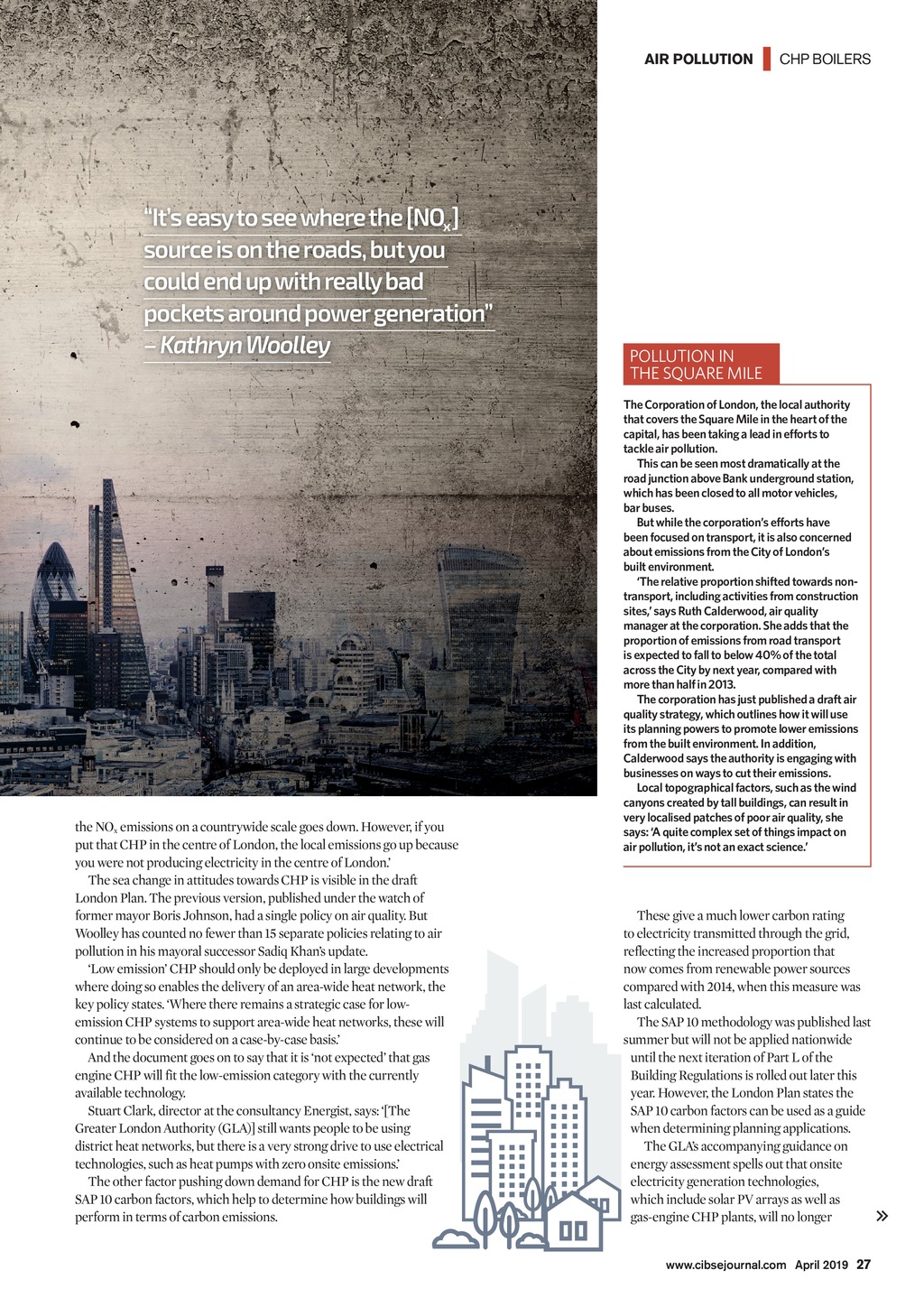


AIR POLLUTION | CHP BOILERS AIMING TO LAND A NOX OUT PUNCH Policies encouraging gas-fired CHPs in London are going into reverse. David Blackman looks at how new air pollution policies will affect the future of heat in the capital W ithin living memory, London was a city of power plants. The Clean Air Act of 1952 put paid to inner Londons power stations like Bankside, which has subsequently been reborn as the Tate Modern art gallery. But the past 10 years have seen this process go into reverse, says Kathryn Woolley, associate consultant, air quality at SLR Consulting: They got all the power stations out of London and, over the past 10 years, weve brought lots of little ones back in. Weve dotted the city with all of these power sources without much understanding. She is referring to the proliferation of mini-combined heat and power (CHP) plants that inner London has seen installed over the past decade. The driver for this spate of mini-power plants has been the backing from the London Plan the capitals spatial development blueprint for CHP plants. CHPs were seen as less wasteful of energy, avoiding the losses that inevitably occur when electricity is transmitted around the grid and less wasted energy translates into lower carbon emissions. The other main driver was the desire to lessen the strain on the capitals grid, which is ageing and difficult to upgrade, given the constraints involved in working in a historic and cramped environment like inner London. But this enthusiasm for CHP hasnt aged well, as public concerns about air quality have rocketed up the agenda. Every week seems to see a fresh report spelling out the dire consequences of air pollution for physical and mental health. And, while motor vehilce transport has attracted much of the public ire over poor air quality, the built environment contributes to the problem too. That includes boilers and CHP plants belching out nitrogen oxides (NOx). Edwin Wealend, associate at Cundall, and chair of the CIBSE Air Quality Group, says: The London Plan strategy has driven the installation of CHP plants without paying too much attention to the NOx emissions. If you are buying a home next to one of those, or in a new development with an energy centre, you could have a very significant amount of NOx compared with the traffic. NOx can be very localised: if you look at NOx monitoring maps for London, the highest concentrations are all along roads, but there are pockets by boiler plants, particularly where there are CHPs. Add to that the spread of diesel generation backup plants and pinpointing air pollution is increasingly hard, says Woolley. At the minute, its easy to see where the source is on the roads, but you could end up with really bad pockets around power generation. CHPs are better than the grid in terms of overall NOx emissions, but not at a more neighbourhood level, says Bill Sinclair, technical director of plant manufacturer Adveco: Every time you fit a CHP, 26 April 2019 www.cibsejournal.com CIBSE Apr19 pp26-28 Air Quality.indd 26 22/03/2019 16:53