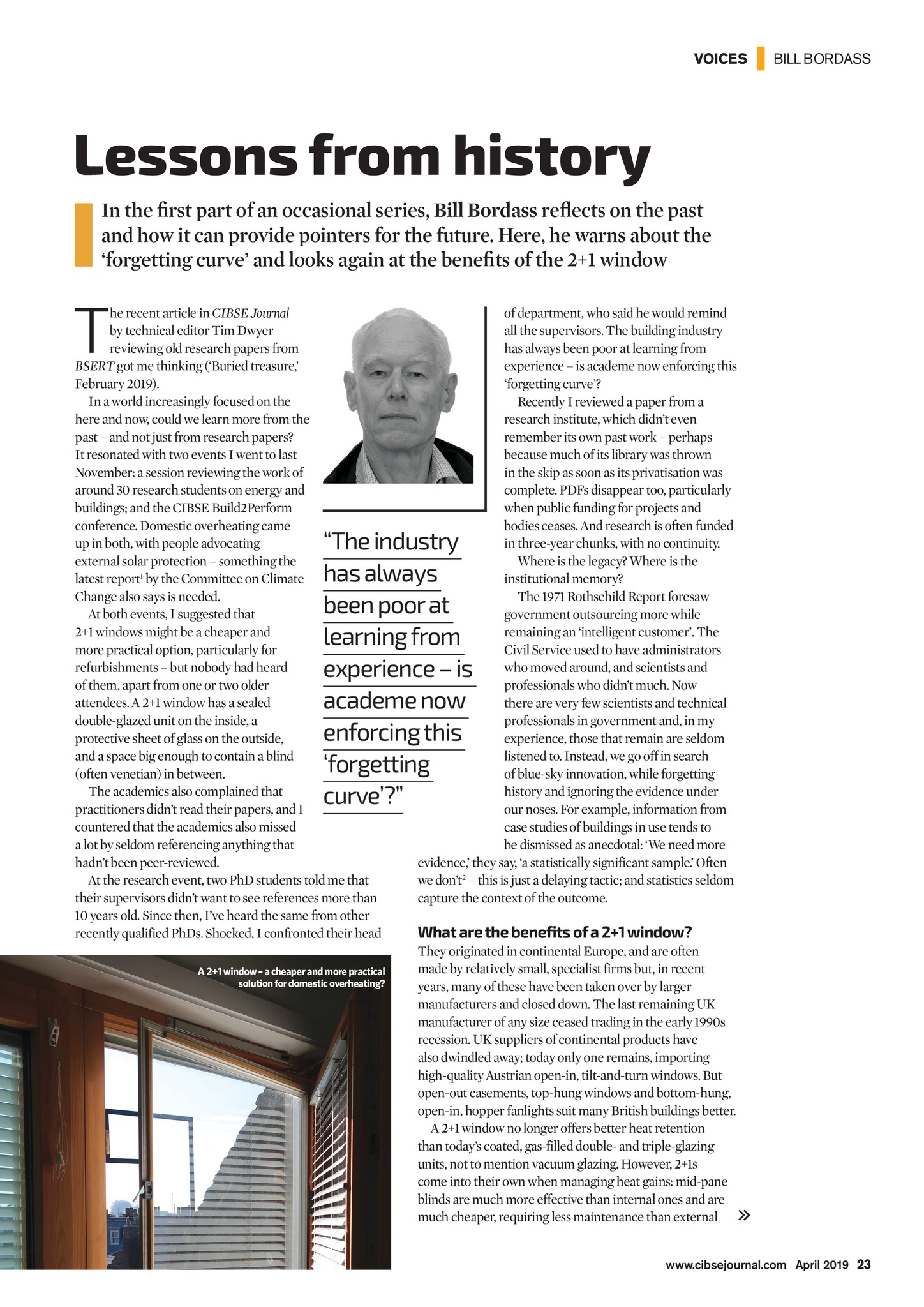
VOICES | BILL BORDASS Lessons from history In the rst part of an occasional series, Bill Bordass reects on the past and how it can provide pointers for the future. Here, he warns about the forgetting curve and looks again at the benets of the 2+1 window T he recent article in CIBSE Journal by technical editor Tim Dwyer reviewing old research papers from BSERT got me thinking (Buried treasure, February 2019). In a world increasingly focused on the here and now, could we learn more from the past and not just from research papers? It resonated with two events I went to last November: a session reviewing the work of around 30 research students on energy and buildings; and the CIBSE Build2Perform conference. Domestic overheating came up in both, with people advocating external solar protection something the latest report1 by the Committee on Climate Change also says is needed. At both events, I suggested that 2+1 windows might be a cheaper and more practical option, particularly for refurbishments but nobody had heard of them, apart from one or two older attendees. A 2+1 window has a sealed double-glazed unit on the inside, a protective sheet of glass on the outside, and a space big enough to contain a blind (often venetian) in between. The academics also complained that practitioners didnt read their papers, and I countered that the academics also missed a lot by seldom referencing anything that hadnt been peer-reviewed. At the research event, two PhD students told me that their supervisors didnt want to see references more than 10 years old. Since then, Ive heard the same from other recently qualified PhDs. Shocked, I confronted their head of department, who said he would remind all the supervisors. The building industry has always been poor at learning from experience is academe now enforcing this forgetting curve? Recently I reviewed a paper from a research institute, which didnt even remember its own past work perhaps because much of its library was thrown in the skip as soon as its privatisation was complete. PDFs disappear too, particularly when public funding for projects and bodies ceases. And research is often funded in three-year chunks, with no continuity. Where is the legacy? Where is the institutional memory? The 1971 Rothschild Report foresaw government outsourcing more while remaining an intelligent customer. The Civil Service used to have administrators who moved around, and scientists and professionals who didnt much. Now there are very few scientists and technical professionals in government and, in my experience, those that remain are seldom listened to. Instead, we go off in search of blue-sky innovation, while forgetting history and ignoring the evidence under our noses. For example, information from case studies of buildings in use tends to be dismissed as anecdotal: We need more evidence, they say, a statistically significant sample. Often we dont2 this is just a delaying tactic; and statistics seldom capture the context of the outcome. The industry has always been poor at learning from experience is academe now enforcing this forgetting curve? A 2+1 window a cheaper and more practical solution for domestic overheating? What are the benefits of a 2+1 window? They originated in continental Europe, and are often made by relatively small, specialist firms but, in recent years, many of these have been taken over by larger manufacturers and closed down. The last remaining UK manufacturer of any size ceased trading in the early 1990s recession. UK suppliers of continental products have also dwindled away; today only one remains, importing high-quality Austrian open-in, tilt-and-turn windows. But open-out casements, top-hung windows and bottom-hung, open-in, hopper fanlights suit many British buildings better. A 2+1 window no longer offers better heat retention than todays coated, gas-filled double- and triple-glazing units, not to mention vacuum glazing. However, 2+1s come into their own when managing heat gains: mid-pane blinds are much more effective than internal ones and are much cheaper, requiring less maintenance than external www.cibsejournal.com April 2019 23 CIBSE Apr19 pp23-24 Bill Bordass.indd 23 22/03/2019 16:52