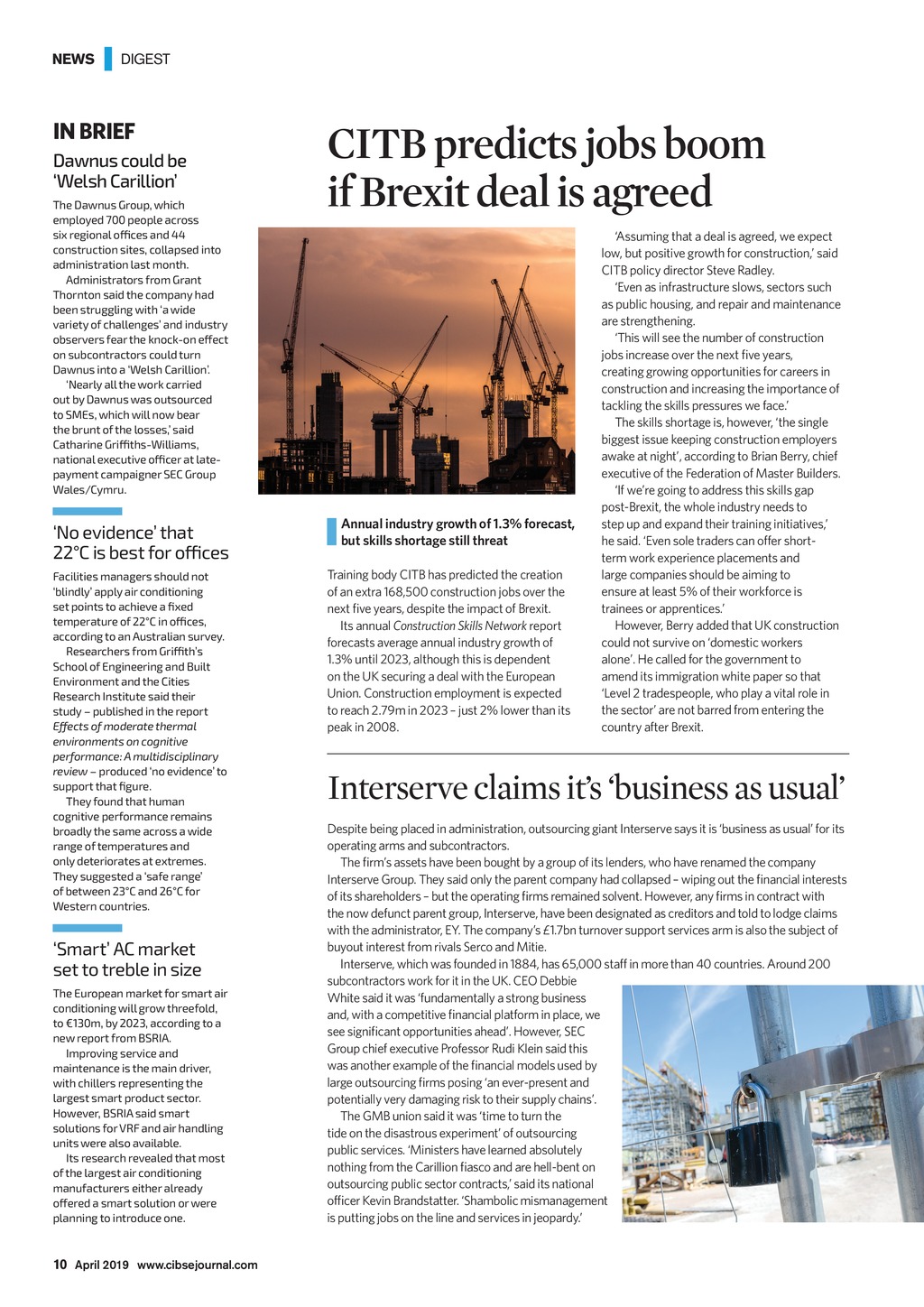


NEWS | DIGEST IN BRIEF Dawnus could be Welsh Carillion The Dawnus Group, which employed 700 people across six regional offices and 44 construction sites, collapsed into administration last month. Administrators from Grant Thornton said the company had been struggling with a wide variety of challenges and industry observers fear the knock-on effect on subcontractors could turn Dawnus into a Welsh Carillion. Nearly all the work carried out by Dawnus was outsourced to SMEs, which will now bear thebrunt of the losses, said Catharine Griffiths-Williams, national executive officer at latepayment campaigner SEC Group Wales/Cymru. No evidence that 22C is best for offices Facilities managers should not blindly apply air conditioning set points to achieve a fixed temperature of 22C in offices, according to an Australian survey. Researchers from Griffiths School of Engineering and Built Environment and the Cities Research Institute said their study published in the report Effects of moderate thermal environments on cognitive performance: A multidisciplinary review produced no evidence to support that figure. They found that human cognitive performance remains broadly the same across a wide range of temperatures and only deteriorates at extremes. They suggested a safe range of between 23C and 26C for Western countries. Smart AC market setto treble in size The European market for smart air conditioning will grow threefold, to 130m, by 2023, according to a new report from BSRIA. Improving service and maintenance is the main driver, with chillers representing the largest smart product sector. However, BSRIA said smart solutions for VRF and air handling units were also available. Its research revealed that most of the largest air conditioning manufacturers either already offered a smart solution or were planning to introduce one. CITB predicts jobs boom if Brexit deal is agreed Annual industry growth of 1.3% forecast, but skills shortage still threat Training body CITB has predicted the creation of an extra 168,500 construction jobs over the next five years, despite the impact of Brexit. Its annual Construction Skills Network report forecasts average annual industry growth of 1.3% until 2023, although this is dependent on the UK securing a deal with the European Union. Construction employment is expected to reach 2.79m in 2023 just 2% lower than its peak in 2008. Assuming that a deal is agreed, we expect low, but positive growth forconstruction, said CITB policy director Steve Radley. Even as infrastructure slows, sectors such aspublic housing, and repair and maintenance are strengthening. This will see the number of construction jobs increase over the next five years, creating growing opportunities for careers in construction and increasing the importance of tackling the skills pressures we face. The skills shortage is, however, the single biggest issue keeping construction employers awake at night, according to Brian Berry, chief executive of the Federation of Master Builders. If were going to address this skills gap post-Brexit, the whole industry needs to step up andexpand their training initiatives, he said.Even sole traders can offer shortterm work experience placements and largecompanies should be aiming to ensureatleast 5% of their workforce is trainees or apprentices. However, Berry added that UK construction could not survive on domestic workers alone. He called for the government to amend its immigration white paper so that Level 2 tradespeople, who play a vital role in the sectorare not barred from entering the country after Brexit. Interserve claims its business as usual Despite being placed in administration, outsourcing giant Interserve says it is business as usual for its operating arms and subcontractors. The firms assets have been bought by a group of its lenders, who have renamed the company Interserve Group. They said only the parent company had collapsed wiping out the financial interests of its shareholders but the operating firms remained solvent. However, any firms in contract with the now defunct parent group, Interserve, have been designated as creditors and told to lodge claims with the administrator, EY. The companys 1.7bn turnover support services arm is also the subject of buyout interest from rivals Serco and Mitie. Interserve, which was founded in 1884, has 65,000 staff in more than 40 countries. Around 200 subcontractors work for it in the UK. CEO Debbie White said it was fundamentally a strong business and, with a competitive financial platform in place, we see significant opportunities ahead. However, SEC Group chief executive Professor Rudi Klein said this was another example of the financial models used by large outsourcing firms posing an ever-present and potentially very damaging risk to their supply chains. The GMB union said it was time to turn the tide on the disastrous experiment of outsourcing public services. Ministers have learned absolutely nothing from the Carillion fiasco and are hell-bent on outsourcing public sector contracts, said its national officer Kevin Brandstatter. Shambolic mismanagement is putting jobs on the line and services in jeopardy. 10 April 2019 www.cibsejournal.com CIBSE Apr19 pp10 News.indd 10 22/03/2019 16:45