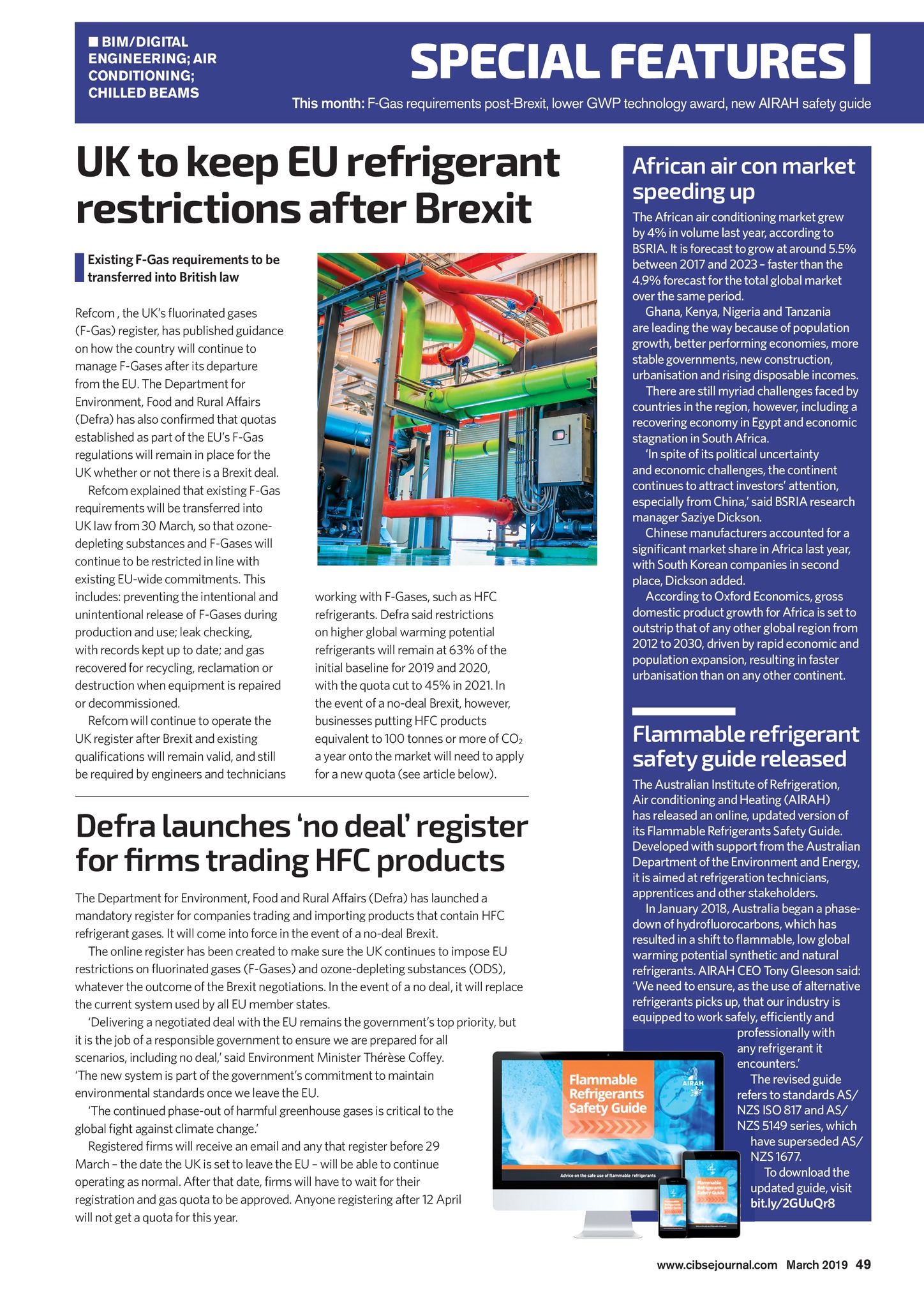
BIM/DIGITAL ENGINEERING; AIR CONDITIONING; CHILLED BEAMS SPECIAL FEATURES This month: F-Gas requirements post-Brexit, lower GWP technology award, new AIRAH safety guide UK to keep EU refrigerant restrictions after Brexit Existing F-Gas requirements to be transferred into British law Refcom , the UKs uorinated gases (F-Gas) register, has published guidance on how the country will continue to manage F-Gases after its departure from the EU. The Department for Environment, Food and Rural Affairs (Defra) has also conrmed that quotas established as part of the EUs F-Gas regulations will remain in place for the UK whether or not there is a Brexit deal. Refcom explained that existing F-Gas requirements will be transferred into UK law from 30 March, so that ozonedepleting substances and F-Gases will continue to be restricted in line with existing EU-wide commitments. This includes: preventing the intentional and unintentional release of F-Gases during production and use; leak checking, with records kept up to date; and gas recovered for recycling, reclamation or destruction when equipment is repaired or decommissioned. Refcom will continue to operate the UK register after Brexit and existing qualications will remain valid, and still be required by engineers and technicians working with F-Gases, such as HFC refrigerants. Defra said restrictions on higher global warming potential refrigerants will remain at 63% of the initial baseline for 2019 and 2020, with the quota cut to 45% in 2021. In the event of a no-deal Brexit, however, businesses putting HFC products equivalent to 100 tonnes or more of CO2 a year onto the market will need to apply for a new quota (see article below). Defra launches no deal register for firms trading HFC products The Department for Environment, Food and Rural Affairs (Defra) has launched a mandatory register for companies trading and importing products that contain HFC refrigerant gases. It will come into force in the event of a no-deal Brexit. The online register has been created to make sure the UK continues to impose EU restrictions on uorinated gases (F-Gases) and ozone-depleting substances (ODS), whatever the outcome of the Brexit negotiations. In the event of a no deal, it will replace the current system used by all EU member states. Delivering a negotiated deal with the EU remains the governments top priority, but it is the job of a responsible government to ensure we are prepared for all scenarios, including no deal, said Environment Minister Thrse Coffey. The new system is part of the governments commitment to maintain environmental standards once we leave the EU. The continued phase-out of harmful greenhouse gases is critical to the global ght against climate change. Registered rms will receive an email and any that register before 29 March the date the UK is set to leave the EU will be able to continue operating as normal. After that date, rms will have to wait for their registration and gas quota to be approved. Anyone registering after 12 April will not get a quota for this year. African air con market speeding up The African air conditioning market grew by 4% in volume last year, according to BSRIA. It is forecast to grow at around 5.5% between 2017 and 2023 faster than the 4.9% forecast for the total global market over the same period. Ghana, Kenya, Nigeria and Tanzania are leading the way because of population growth, better performing economies, more stable governments, new construction, urbanisation and rising disposable incomes. There are still myriad challenges faced by countries in the region, however, including a recovering economy in Egypt and economic stagnation in South Africa. In spite of its political uncertainty and economic challenges, the continent continues to attract investors attention, especially from China, said BSRIA research manager Saziye Dickson. Chinese manufacturers accounted for a signicant market share in Africa last year, with South Korean companies in second place, Dickson added. According to Oxford Economics, gross domestic product growth for Africa is set to outstrip that of any other global region from 2012 to 2030, driven by rapid economic and population expansion, resulting in faster urbanisation than on any other continent. Flammable refrigerant safety guide released The Australian Institute of Refrigeration, Air conditioning and Heating (AIRAH) has released an online, updated version of its Flammable Refrigerants Safety Guide. Developed with support from the Australian Department of the Environment and Energy, it is aimed at refrigeration technicians, apprentices and other stakeholders. In January 2018, Australia began a phasedown of hydrouorocarbons, which has resulted in a shift to ammable, low global warming potential synthetic and natural refrigerants. AIRAH CEO Tony Gleeson said: We need to ensure, as the use of alternative refrigerants picks up, that our industry is equipped to work safely, efciently and professionally with any refrigerant it encounters. The revised guide refers to standards AS/ NZS ISO 817 and AS/ NZS 5149 series, which have superseded AS/ NZS 1677. To download the updated guide, visit bit.ly/2GUuQr8 www.cibsejournal.com March 2019 49 CIBSE Mar19 pp49-50 Cooling News.indd 49 22/02/2019 16:42