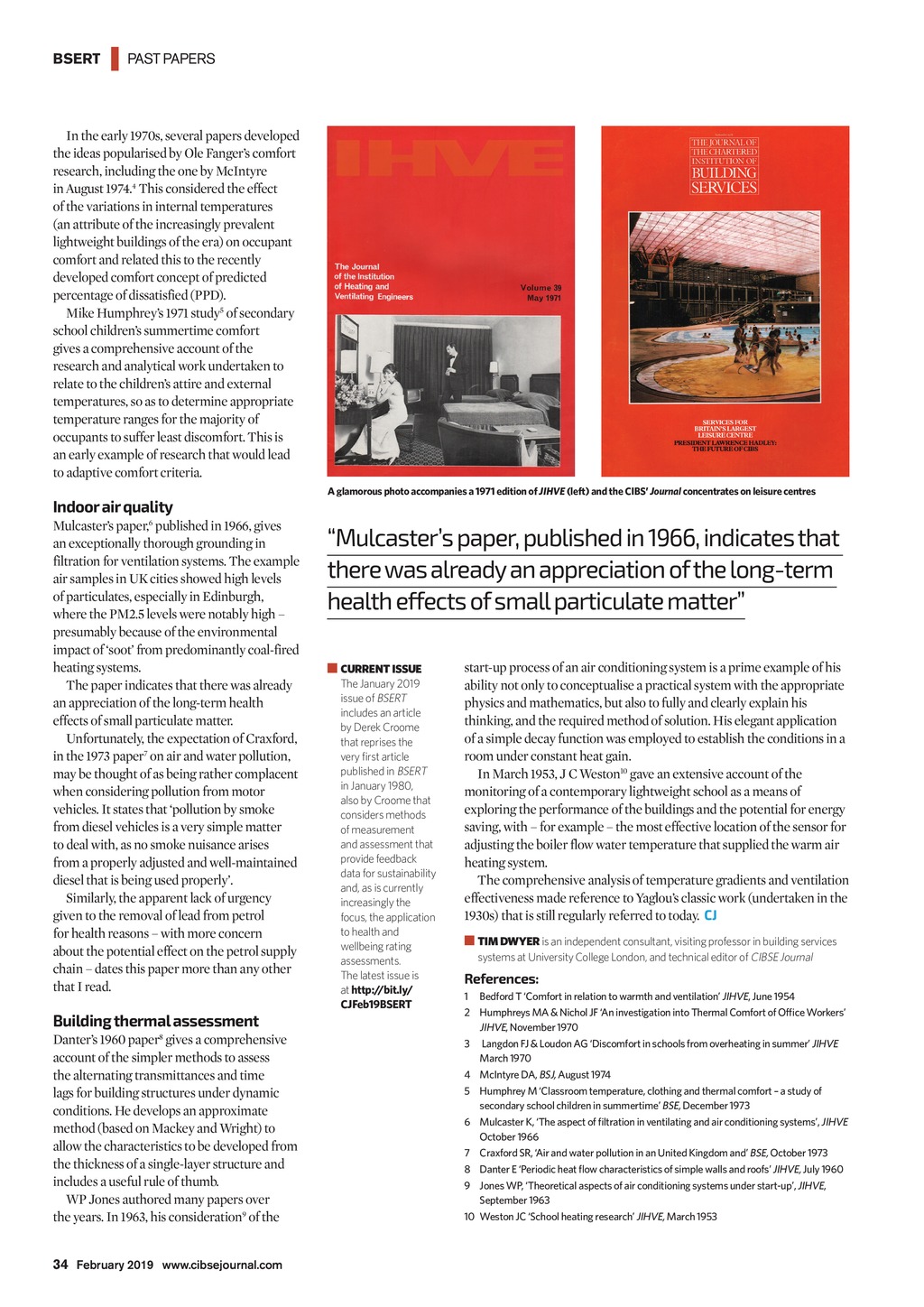



BSERT | PAST PAPERS In the early 1970s, several papers developed the ideas popularised by Ole Fangers comfort research, including the one by McIntyre in August 1974.4 This considered the effect of the variations in internal temperatures (an attribute of the increasingly prevalent lightweight buildings of the era) on occupant comfort and related this to the recently developed comfort concept of predicted percentage of dissatisfied (PPD). Mike Humphreys 1971 study5 of secondary school childrens summertime comfort gives a comprehensive account of the research andanalytical work undertaken to relate to the childrens attire and external temperatures, so as to determine appropriate temperature ranges for the majority of occupants to suffer least discomfort. This is anearly example of research that would lead to adaptive comfort criteria. A glamorous photo accompanies a 1971 edition of JIHVE (left) and the CIBS Journal concentrates on leisure centres Indoor air quality Mulcasters paper,6 published in 1966, gives an exceptionally thorough grounding in filtration for ventilation systems. The example air samples in UK cities showed high levels of particulates, especially in Edinburgh, where the PM2.5 levels were notably high presumably because of the environmental impact of soot from predominantly coal-fired heating systems. The paper indicates that there was already an appreciation of the long-term health effects of small particulate matter. Unfortunately, the expectation of Craxford, in the 1973 paper7 on air and water pollution, may be thought of as being rather complacent when considering pollution from motor vehicles. It states that pollution by smoke from diesel vehicles is a very simple matter todeal with, as no smoke nuisance arises from a properly adjusted and well-maintained diesel that is being used properly. Similarly, the apparent lack of urgency given to the removal of lead from petrol forhealth reasons with more concern aboutthepotential effect on the petrol supply chain dates this paper more than any other that I read. Building thermal assessment Danters 1960 paper8 gives a comprehensive account of the simpler methods to assess the alternating transmittances and time lags for building structures under dynamic conditions. He develops an approximate method (based on Mackey and Wright) to allow the characteristics to be developed from the thickness of a single-layer structure and includes a useful rule of thumb. WP Jones authored many papers over the years. In 1963, his consideration9 of the Mulcasters paper, published in 1966, indicates that there was already an appreciation of the long-term health effects of small particulate matter C URRENT ISSUE The January 2019 issue of BSERT includes an article by Derek Croome that reprises the very first article published in BSERT in January 1980, also by Croome that considers methods of measurement and assessment that provide feedback data for sustainability and, as is currently increasingly the focus, the application to health and wellbeing rating assessments. The latest issue is at http://bit.ly/ CJFeb19BSERT start-up process of an air conditioning system is a prime example of his ability not only to conceptualise a practical system with the appropriate physics and mathematics, but also to fully and clearly explain his thinking, and the required method of solution. His elegant application of a simple decay function was employed to establish the conditions in a room under constant heat gain. In March 1953, J C Weston10 gave an extensive account of the monitoring of a contemporary lightweight school as a means of exploring the performance of the buildings and the potential for energy saving, with for example the most effective location of the sensor for adjusting the boiler flow water temperature that supplied the warm air heating system. The comprehensive analysis of temperature gradients and ventilation effectiveness made reference to Yaglous classic work (undertaken in the 1930s) that is still regularly referred to today. CJ TIM DWYER is an independent consultant, visiting professor in building services systems at University College London, and technical editor of CIBSE Journal References: 1 Bedford T Comfort in relation to warmth and ventilation JIHVE, June 1954 2 Humphreys MA & Nichol JF An investigation into Thermal Comfort of Office Workers JIHVE, November 1970 3 Langdon FJ & Loudon AG Discomfort in schools from overheating in summer JIHVE March 1970 4 McIntyre DA, BSJ, August 1974 5 Humphrey M Classroom temperature, clothing and thermal comfort a study of secondary school children in summertime BSE, December 1973 6 Mulcaster K, The aspect of filtration in ventilating and air conditioning systems, JIHVE October 1966 7 Craxford SR, Air and water pollution in an United Kingdom and BSE, October 1973 8 Danter E Periodic heat flow characteristics of simple walls and roofs JIHVE, July 1960 9 Jones WP, Theoretical aspects of air conditioning systems under start-up, JIHVE, September 1963 10 Weston JC School heating research JIHVE, March 1953 34 February 2019 www.cibsejournal.com CIBSE Feb19 pp33-34 BSERT.indd 34 25/01/2019 16:11