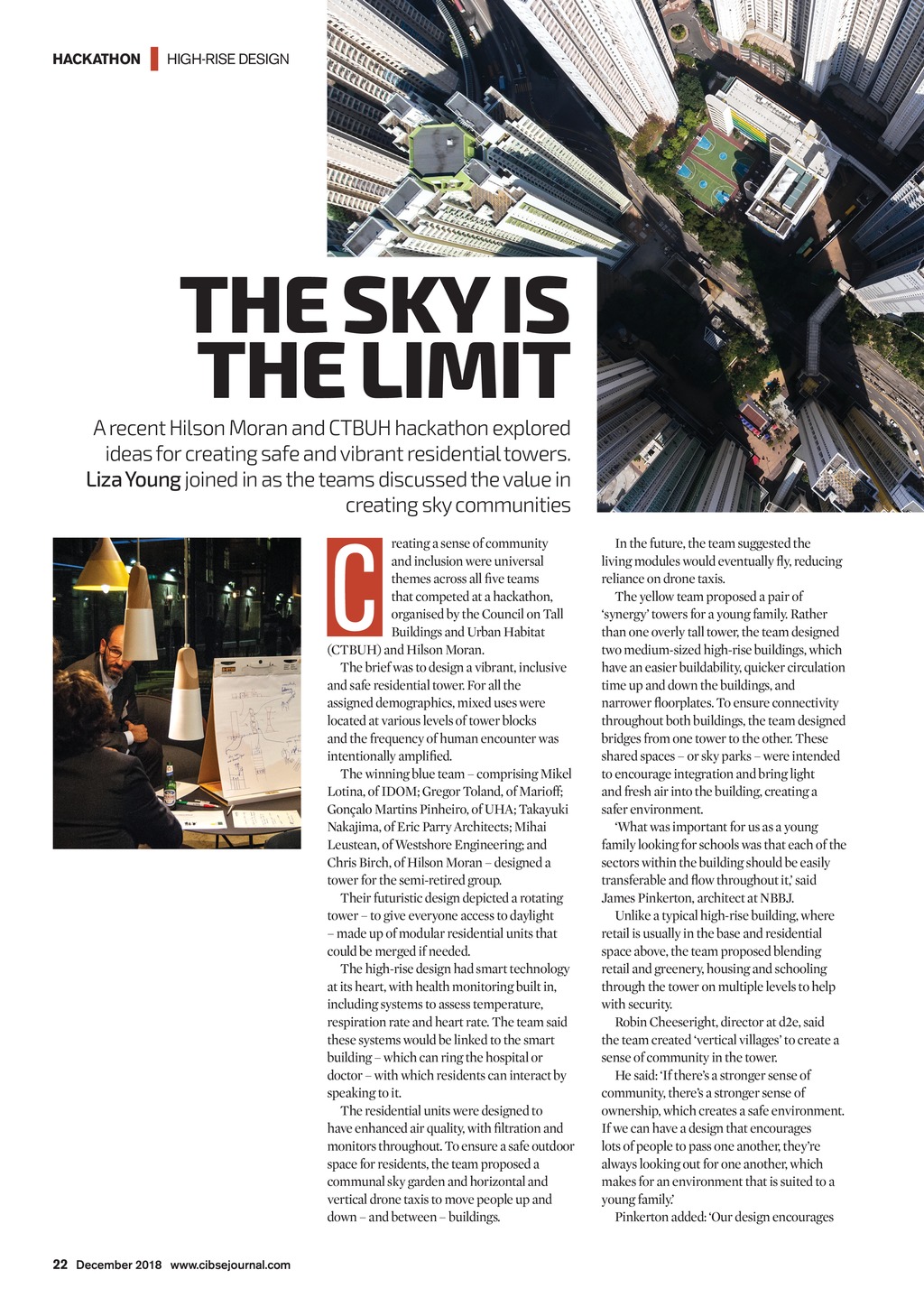

Hackathon | High-rise design The sky is the limit A recent Hilson Moran and CTBUH hackathon explored ideas for creating safe and vibrant residential towers. Liza Young joined in as the teams discussed the value in creating sky communities C reating a sense of community and inclusion were universal themes across all five teams that competed at a hackathon, organised by the Council on Tall Buildings and Urban Habitat (CTBUH) and Hilson Moran. The brief was to design a vibrant, inclusive and safe residential tower. For all the assigned demographics, mixed uses were located at various levels of tower blocks and the frequency of human encounter was intentionally amplified. The winning blue team comprising Mikel Lotina, of IDOM; Gregor Toland, of Marioff; Gonalo Martins Pinheiro, of UHA; Takayuki Nakajima, of Eric Parry Architects; Mihai Leustean, of Westshore Engineering; and Chris Birch, of Hilson Moran designed a tower for the semi-retired group. Their futuristic design depicted a rotating tower to give everyone access to daylight made up of modular residential units that could be merged if needed. The high-rise design had smart technology at its heart, with health monitoring built in, including systems to assess temperature, respiration rate and heart rate. The team said these systems would be linked to the smart building which can ring the hospital or doctor with which residents can interact by speaking to it. The residential units were designed to have enhanced air quality, with filtration and monitors throughout. To ensure a safe outdoor space for residents, the team proposed a communal sky garden and horizontal and vertical drone taxis to move people up and down and between buildings. In the future, the team suggested the living modules would eventually fly, reducing reliance on drone taxis. The yellow team proposed a pair of synergy towers for a young family. Rather than one overly tall tower, the team designed two medium-sized high-rise buildings, which have an easier buildability, quicker circulation time up and down the buildings, and narrower floorplates. To ensure connectivity throughout both buildings, the team designed bridges from one tower to the other. These shared spaces or sky parks were intended to encourage integration and bring light and fresh air into the building, creating a saferenvironment. What was important for us as a young family looking for schools was that each of the sectors within the building should be easily transferable and flow throughout it, said James Pinkerton, architect at NBBJ. Unlike a typical high-rise building, where retail is usually in the base and residential space above, the team proposed blending retail and greenery, housing and schooling through the tower on multiple levels to help with security. Robin Cheeseright, director at d2e, said the team created vertical villages to create a sense of community in the tower. He said: If theres a stronger sense of community, theres a stronger sense of ownership, which creates a safe environment. If we can have a design that encourages lots of people to pass one another, theyre always looking out for one another, which makes for an environment that is suited to a young family. Pinkerton added: Our design encourages 22 December 2018 www.cibsejournal.com CIBSE Dec18 pp22-23 Hackathon.indd 22 23/11/2018 15:57