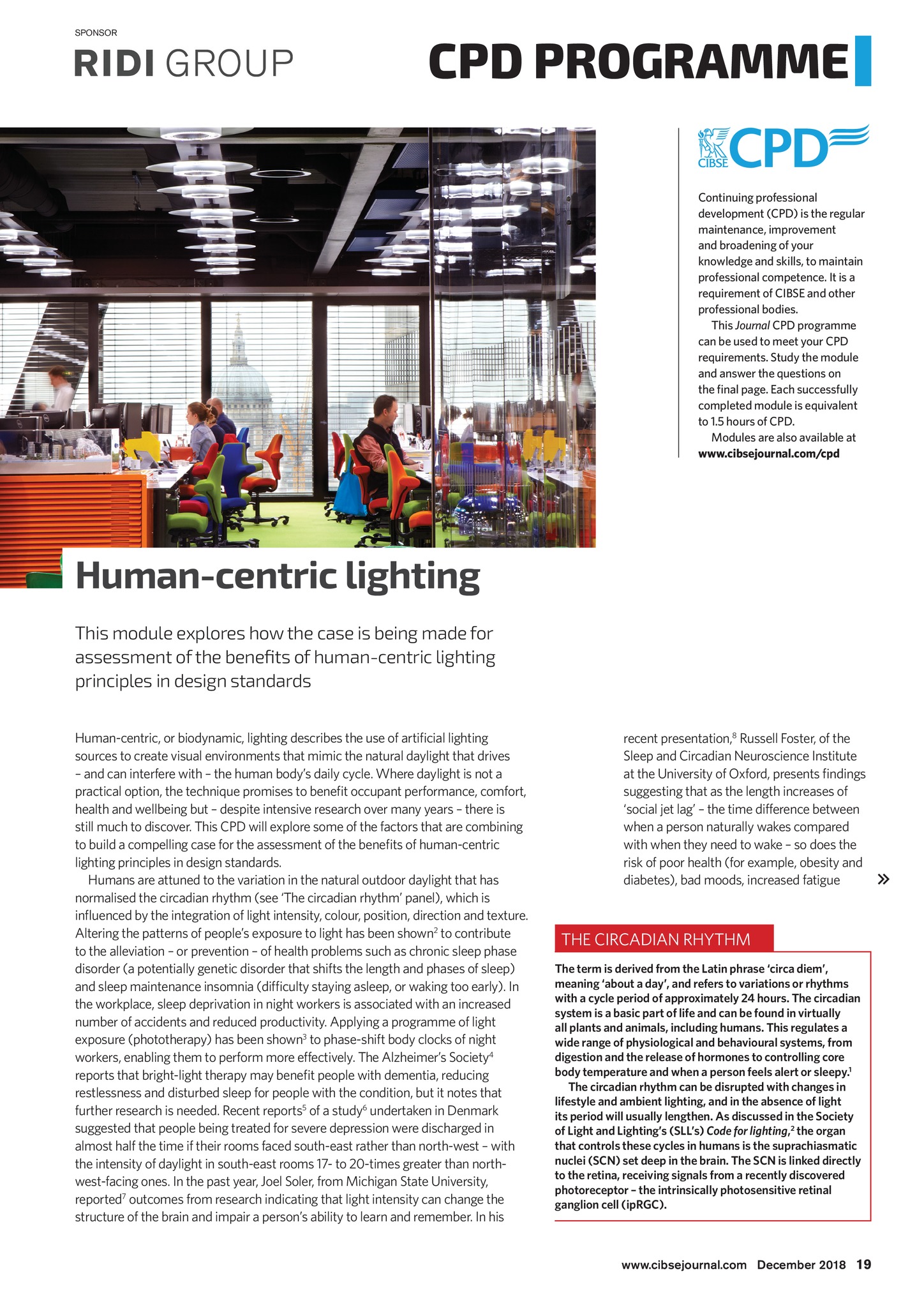
SPONSOR CPD PROGRAMME Continuing professional development (CPD) is the regular maintenance, improvement and broadening of your knowledge and skills, to maintain professional competence. It is a requirement of CIBSE and other professional bodies. This Journal CPD programme can be used to meet your CPD requirements. Study the module and answer the questions on the final page. Each successfully completed module is equivalent to 1.5 hours of CPD. Modules are also available at www.cibsejournal.com/cpd Human-centric lighting This module explores how the case is being made for assessment of the benefits of human-centric lighting principles in design standards Human-centric, or biodynamic, lighting describes the use of artificial lighting sources to create visual environments that mimic the natural daylight that drives and can interfere with the human bodys daily cycle. Where daylight is not a practical option, the technique promises to benefit occupant performance, comfort, health and wellbeing but despite intensive research over many years there is still much to discover. This CPD will explore some of the factors that are combining to build a compelling case for the assessment of the benefits of human-centric lighting principles in design standards. Humans are attuned to the variation in the natural outdoor daylight that has normalised the circadian rhythm (see The circadian rhythm panel), which is influenced by the integration of light intensity, colour, position, direction and texture. Altering the patterns of peoples exposure to light has been shown2 to contribute to the alleviation or prevention of health problems such as chronic sleep phase disorder (a potentially genetic disorder that shifts the length and phases of sleep) and sleep maintenance insomnia (difficulty staying asleep, or waking too early). In the workplace, sleep deprivation in night workers is associated with an increased number of accidents and reduced productivity. Applying a programme of light exposure (phototherapy) has been shown3 to phase-shift body clocks of night workers, enabling them to perform more effectively. The Alzheimers Society4 reports that bright-light therapy may benefit people with dementia, reducing restlessness and disturbed sleep for people with the condition, but it notes that further research is needed. Recent reports5 of a study6 undertaken in Denmark suggested that people being treated for severe depression were discharged in almost half the time if their rooms faced south-east rather than north-west with the intensity of daylight in south-east rooms 17- to 20-times greater than northwest-facing ones. In the past year, Joel Soler, from Michigan State University, reported7 outcomes from research indicating that light intensity can change the structure of the brain and impair a persons ability to learn and remember. In his recent presentation,8 Russell Foster, of the Sleep and Circadian Neuroscience Institute at the University of Oxford, presents findings suggesting that as the length increases of social jet lag the time difference between when a person naturally wakes compared with when they need to wake so does the risk of poor health (for example, obesity and diabetes), bad moods, increased fatigue The circadian rhythm The term is derived from the Latin phrase circa diem, meaning about a day, and refers to variations or rhythms with a cycle period of approximately 24 hours. The circadian system is a basic part of life and can be found in virtually all plants and animals, including humans. This regulates a wide range of physiological and behavioural systems, from digestion and the release of hormones to controlling core body temperature and when a person feels alert or sleepy.1 The circadian rhythm can be disrupted with changes in lifestyle and ambient lighting, and in the absence of light its period will usually lengthen. As discussed in the Society of Light and Lightings (SLLs) Code for lighting,2 the organ that controls these cycles in humans is the suprachiasmatic nuclei (SCN) set deep in the brain. The SCN is linked directly to the retina, receiving signals from a recently discovered photoreceptor the intrinsically photosensitive retinal ganglion cell (ipRGC). www.cibsejournal.com December 2018 19 CIBSE Nov18 Supp pp19-22 CPD 139 v2.indd 19 23/11/2018 12:59